Mastering in Automation Project Management
Leading Successful Automation Initiatives for Tomorrow’s Businesses
In an age where automation is revolutionizing business operations, Mastering in Automation Project management is essential for those aiming to spearhead transformation initiatives. Our Mastering in Automation Project Management course equips students with the vital skills and knowledge required to lead and manage automation projects effectively. This course serves as a crucial step for recent graduates, professionals, and aspiring project managers, empowering them to oversee processes that enhance operational efficiency. With a strong emphasis on practical application, this program ensures you gain hands-on experience in managing automation projects from inception to completion. Through real-world projects and expert mentorship, you’ll develop the strategic mindset to navigate the complexities of automation initiatives across industries. Unlock your potential to lead transformative projects and position yourself for immediate job opportunities in both local and global markets.
Course Duration
3 Months | 2 hours per day | 5 days a week
Internship Duration
3 Months | Full Time
Course Fee
Rs. 45000/-
*50% at the time of admission & 50% during Internship Earnings.
Eligibility
Graduating, Recent graduates, graduates and professionals.
Available Seats
36 Students
Course Advantage
Learning Outcomes
Grasp the complete lifecycle of automation projects, from planning and initiation to execution, monitoring, and closure, ensuring comprehensive project management skills.
Develop expertise in various automation tools and technologies, such as RPA platforms and project management software, to effectively implement and manage automation initiatives.
Learn to create strategic plans for automation projects, including scope definition, resource allocation, risk management, and timeline estimation to ensure successful project outcomes.
Understand the principles of change management, enabling you to effectively lead teams through transitions associated with automation and mitigate resistance.
Acquire the ability to set key performance indicators (KPIs) and measure the success of automation projects, ensuring continuous improvement and alignment with business goals.
Develop strong leadership and communication skills necessary for coordinating cross-functional teams, facilitating collaboration, and ensuring stakeholder engagement throughout the project.
Apply project management methodologies, such as Agile and Waterfall, to real-world automation projects, enhancing your ability to adapt to different project requirements and environments.
Reasons to Enroll
Automation is rapidly transforming industries, creating a strong demand for skilled project managers who can lead automation initiatives. This course prepares you for in-demand roles in a growing job market.
The course covers essential aspects of automation project management, including planning, execution, and change management, providing you with a well-rounded skill set applicable to various industries.
Engage in real-world projects that allow you to apply your knowledge in practical settings, enhancing your learning experience and preparing you for real challenges in the workplace.
Benefit from mentorship and insights from industry professionals who bring a wealth of experience and knowledge, helping you navigate the complexities of automation projects effectively.
Connect with like-minded peers, industry experts, and potential employers, expanding your professional network and opening doors to new career opportunities.
Equip yourself with specialized skills that enhance your employability, positioning you for immediate job opportunities in both local and global markets after course completion.
The skills acquired in this course are transferable across different sectors, enabling you to pursue diverse career paths, whether in IT, finance, healthcare, or manufacturing.
Career Opportunities & Pathways
Oversee automation projects from planning to execution, ensuring they are completed on time and within budget while meeting business objectives.
Analyze and optimize business processes, identifying areas for automation and implementing solutions to enhance efficiency and effectiveness.
Design, develop, and implement Robotic Process Automation (RPA) solutions to automate repetitive tasks and improve business workflows.
Facilitate the transition to automated processes by managing organizational change, ensuring employees are supported and trained throughout the automation journey.
Manage operations teams focused on automating processes across departments, driving efficiency and effectiveness in business operations.
Work with businesses to assess their automation needs, recommend solutions, and guide them through the implementation of automation strategies.
Lead large-scale automation programs, coordinating multiple projects and teams to achieve strategic goals related to automation and digital transformation.
Curriculum
— Introduction to automation project management concepts.
— Project management frameworks (Agile, Waterfall, and Hybrid) in automation.
— Fundamentals of RPA and its applications in project management.
— Essential skills for automation project managers.
— Defining project scope, objectives, and outcomes.
— Developing an automation project plan and timeline.
— Identifying project stakeholders and managing expectations.
— Case studies on successful automation project management.
— Real-life examples of automation project outcomes.
— Creating project plans with milestones, phases, and timelines.
— Allocating resources and managing budgets for automation projects.
— Setting Key Performance Indicators (KPIs) for automation projects.
— Risk assessment and contingency planning.
— Creating project timelines with Gantt charts, Trello, and MS Project.
— Resource planning and workload balancing.
— Estimating costs and budget forecasting.
— Using resource management tools.
— Case studies on resource allocation in automation.
— Understanding stakeholder roles in automation projects.
— Strategies for identifying and analyzing stakeholders.
— Developing stakeholder engagement plans and communication strategies.
— Effective communication techniques for project updates and feedback.
— Building relationships with stakeholders through active listening and empathy.
— Managing stakeholder expectations and addressing concerns.
— Techniques for facilitating productive stakeholder meetings.
— Tools for collaboration and communication (Slack, Microsoft Teams, etc.).
— Case studies on effective stakeholder engagement in automation projects.
— Executing automation project plans in a structured manner.
— Building and leading cross-functional teams for automation.
— Delegating responsibilities and managing team dynamics.
— Managing remote teams for automation projects.
— Daily monitoring and managing project activities.
— Communication best practices within project teams.
— Conflict resolution and team motivation.
— Overcoming common challenges in automation project execution.
— Case studies on team management in automation projects.
— Developing quality standards for automation deliverables.
— Testing automation workflows and ensuring functionality.
— Identifying and fixing process bottlenecks.
— Conducting user acceptance testing (UAT) for automated processes.
— Monitoring accuracy and efficiency of automated processes.
— Using automation testing tools for RPA and workflow validation.
— Quality control techniques and best practices.
— Case studies on successful quality assurance in automation.
— Real-life examples of testing automation systems.
— Managing organizational change during automation implementation.
— Planning for adoption: preparing users for automation integration.
— Developing training programs for end-users.
— Creating user manuals and support documentation.
— Encouraging a culture of digital transformation within organizations.
— Managing resistance to automation and digital tools.
— Measuring user engagement and process adoption.
— Continuous feedback loops for process improvement.
— Case studies on change management in automation projects.
— Reviewing project outcomes and assessing automation impact.
— Measuring ROI and key success metrics.
— Conducting post-implementation audits and troubleshooting.
— Continuous monitoring and optimization of automated systems.
— Scaling successful automation solutions across departments.
— Building strategies for long-term maintenance and improvement.
— Incorporating analytics for ongoing system refinement.
— Reporting to stakeholders and closing projects.
— Case studies on continuous improvement in automation projects.
Certification
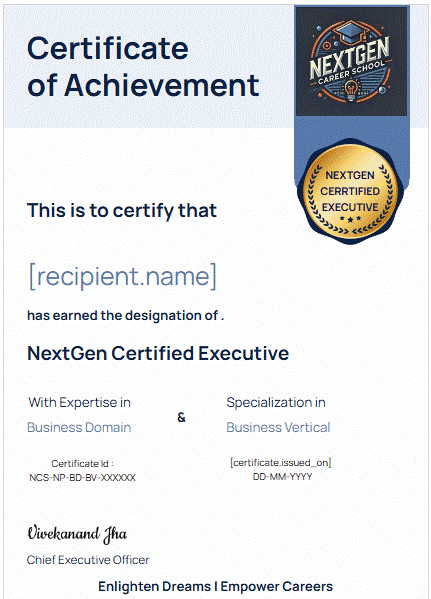
Elevate your resume with NextGen certification
Get Certified as a Business Executive
Become a NextGen Certified Business Executive and join an exclusive network of successful professionals who have completed the Mastering in Automation Project Management program at NextGen Career School.
Start immediately by enrolling through our simple online application process.
Frequently Asked Questions
The Mastering in Automation Project Management program is a comprehensive course designed to equip students with the skills and knowledge needed to effectively manage automation projects. The program focuses on methodologies and best practices for planning, executing, and monitoring automation initiatives within organizations.
Key benefits of the program include:
— Comprehensive understanding of project management methodologies specific to automation.
— Hands-on experience with real-world automation projects and case studies.
— Enhanced career opportunities in a rapidly growing field focused on automation.
— Access to expert instructors with industry experience in automation and project management.
— Networking opportunities with fellow students and industry professionals.
The program consists of 63 classes divided into 7 modules, with each module containing 9 classes. It is delivered over a 3-month period, with classes held 5 days a week. The curriculum combines theoretical foundations with practical applications in automation project management.
After completing the Mastering in Automation Project Management course, students can pursue various career opportunities such as Automation Project Manager, Process Automation Consultant, Change Manager, and Operations Lead, allowing them to deepen their expertise and enhance their career prospects.
The program is open to recent graduates, undergraduates, and professionals interested in automation project management. A basic understanding of project management concepts and a willingness to learn are beneficial, but prior experience in automation projects is not mandatory.
To earn the certificate, students must complete all course modules, attend the required classes, and successfully pass the assessments and the capstone project associated with the program.
Yes, our placement cell provides support and guidance to students seeking job opportunities after completing the program. This includes resume building, interview preparation, and connections with potential employers in the fields of automation project management and process optimization.
Focused Specialization Programs
Mastering in Data Analytics
Empower professionals to analyze data, uncover insights, and drive data-driven decisions for business optimization.
Mastering in Business Process Analysis
Equip professionals with skills to analyze and optimize business processes for greater efficiency and decision-making.
Mastering in Robotic Process Automation
Equip professionals with skills to automate tasks, streamline processes, and boost operational efficiency using RPA technologies.
One-to-One Online Consultation
Tailored Guidance for Your Success
Get personalized, one-to-one online consultations for Career Guidance, Employment Guidance, Admission Guidance with our expert advisors. Receive tailored guidance and actionable insights to achieve your goals.