Mastering in Data Analytics
Turning Data into Actionable Insights for a Competitive Edge
In an era where data drives every strategic decision, mastering data analytics is essential to gain a competitive advantage and unlock valuable insights. Our Mastering in Data Analytics course is designed to equip recent graduates and professionals with advanced analytical skills, emphasizing practical application and hands-on experience with leading data analysis tools like Python, R, and SQL.
Through real-world projects and personalized mentorship, you’ll learn to transform complex data into actionable insights, enabling smarter decision-making and strategic growth. Elevate your career prospects, become a vital asset to any organization, and stand at the cutting edge of the data-driven future. Join us to harness the power of data, and become a catalyst for meaningful impact and success in the modern business world!
Course Duration
3 Months | 2 hours per day | 5 days a week
Course Fee
Rs. 54000/-
*50% at the time of admission & 50% after Internship Earnings or during certification.
Eligibility
undergraduates, Recent graduates, graduates and professionals.
Available Seats
30 Students
Course Advantage
Learning Outcomes
Students will gain the ability to prepare, clean, and manage large datasets effectively, ensuring data accuracy and reliability through tools like SQL, Excel, and Python.
Learners will develop skills to create meaningful visualizations using tools like Tableau and Power BI, enabling them to present complex data insights clearly and effectively to stakeholders.
Students will learn statistical methods and probability concepts that are essential in interpreting data trends, patterns, and relationships for more accurate decision-making.
Participants will gain an understanding of predictive modeling and machine learning techniques such as regression, classification, and clustering to forecast future trends and outcomes.
Learners will become proficient in using EDA to understand the underlying patterns in data, detect outliers, and establish foundational insights that guide deeper analysis.
Students will learn how to translate data insights into compelling narratives, equipping them with the skills to communicate findings effectively to both technical and non-technical audiences.
Students will gain knowledge of ethical standards in data analytics, including data privacy laws, bias mitigation, and the ethical use of data, preparing them to handle data responsibly.
Reasons to Enroll
Data analytics skills are in high demand across industries, from finance to healthcare and beyond. Completing this course opens up opportunities in numerous high-growth sectors.
With real-world projects, case studies, and industry-standard tools like Python, SQL, and Tableau, students gain practical experience that can be immediately applied in professional settings.
The course fosters critical thinking and analytical skills, enabling students to derive meaningful insights from data to solve complex business challenges.
Students learn popular and versatile tools like Power BI, R, and Excel, preparing them to work with any data ecosystem and setting them apart in the competitive job market.
Participants benefit from personalized mentorship and collaboration with peers, creating a network of support and resources to excel in their data analytics journey.
Data analytics professionals are among the most well-compensated in the tech sector, with roles in data science, business intelligence, and predictive analytics offering strong growth trajectories.
As organizations become increasingly data-driven, professionals with analytics expertise are essential. This course equips students with skills that will continue to be valuable and relevant in the future of work.
Career Opportunities & Pathways
Data analysts work with large datasets to find actionable insights and support decision-making within an organization, using skills in data manipulation, visualization, and reporting.
BI analysts focus on transforming data into insights that help businesses make strategic decisions. They often work with BI tools like Power BI or Tableau to create dashboards and visual reports.
Data scientists use statistical analysis, machine learning, and programming to uncover complex patterns, forecast trends, and guide data-driven strategies, making this role one of the most sought-after in data analytics.
Marketing analysts use data to assess marketing campaign effectiveness, customer behavior, and market trends. This role is ideal for those interested in combining data analysis with marketing strategy.
Financial analysts leverage data analytics to guide financial decisions, forecast economic conditions, and evaluate investment opportunities, often working with large datasets to provide insights into financial trends.
Operations analysts focus on optimizing business processes, using data to improve efficiency, manage resources, and streamline production or logistics operations.
Product analysts use data to evaluate product performance, customer feedback, and usage trends, helping companies make data-driven decisions in product development, enhancements, and user experience.
Curriculum
Introduces the key concepts and principles of data analytics, setting the foundation for advanced topics in later modules.
— Introduction to Data Analytics – Definition, Importance, and Applications
— Data Analytics vs Business Intelligence – Key Differences and Overlap
— Role of Statistics in Data Analytics – Descriptive and Inferential Statistics
— Understanding Data Types and Variables – Quantitative vs Qualitative Data
— Overview of Data Collection Methods – Surveys, Sensors, Transactional Data
— Sampling Methods and Data Representativeness – Techniques and Bias Reduction
— Introduction to Data Lifecycle in Analytics – From Collection to Analysis
— Data Engineering Essentials – Basics of Data Pipelines and Data Architecture
— Case Studies – Real-World Applications of Data Analytics
Focuses on collecting, cleaning, and preparing data for effective analysis.
— Data Wrangling Techniques – Cleaning, Formatting, and Standardizing Data
— Exploratory Data Analysis (EDA) – Visualizing Patterns and Relationships
— Handling Missing Values – Techniques for Imputation and Deletion
— Outlier Detection and Treatment – Identifying and Managing Outliers
— Data Transformation Techniques – Scaling, Encoding, and Binning
— Data Normalization and Standardization – Preparing Data for Modeling
— Feature Engineering – Creating New Variables to Improve Predictive Power
— Dimensionality Reduction Techniques – PCA, LDA, and t-SNE
— Tools for Data Preparation and Exploration – Pandas, NumPy, and SciPy
Covers statistical concepts and techniques fundamental to data analysis and decision-making.
— Introduction to Probability Theory – Basic Probability and Rules
— Statistical Distributions – Normal, Binomial, Poisson, etc.
— Hypothesis Testing – T-tests, Chi-Square Tests, ANOVA
— Confidence Intervals and Estimation – Interpretation and Calculation
— Correlation vs Causation – Understanding Relationships
— Regression Analysis Basics – Simple Linear and Multiple Regression
— Statistical Significance – p-values, Alpha Levels, and Power
— Non-parametric Tests – Wilcoxon, Kruskal-Wallis, and Mann-Whitney U
— Statistical Software Overview – R, SPSS, and SAS
Delves into advanced analytical techniques, with a focus on predictive and prescriptive analytics.
— Supervised Learning – Linear Regression, Logistic Regression
— Unsupervised Learning – Clustering Techniques (K-Means, Hierarchical)
— Dimensionality Reduction in Analytics – PCA, Factor Analysis
— Text Analytics and Natural Language Processing (NLP) – Basics and Applications
— Sentiment Analysis and Opinion Mining – Techniques and Tools
— Time-Series Analysis – ARIMA, Moving Average, and Seasonal Decomposition
— Predictive Analytics – Using Historical Data for Forecasting
— Optimization Techniques in Analytics – Linear and Non-linear Optimization
— Case Studies in Predictive Analytics – Industry Applications and Examples
Focuses on effective data visualization and the art of data storytelling tailored for analysts.
— Principles of Effective Data Visualization – Designing with Purpose
— Visual Storytelling in Data Analytics – Structuring Insights for Impact
— Visualization Types – Histograms, Box Plots, Scatter Plots, and Heat Maps
— Creating Interactive Visuals – Using Power BI/Tableau for Data Analysis
— Geospatial Analytics and Mapping – Choropleth Maps and Location-Based Data
— Color Theory in Data Visualization – Choosing Effective Color Schemes
— Avoiding Misleading Visualizations – Ethics in Data Representation
— Dashboard Design Principles – Organizing and Interpreting Data
— Effective Data Presentation Skills – Tailoring Messages for Stakeholders
Covers key concepts and techniques in machine learning for data analytics, with a focus on predictive modeling.
— Introduction to Machine Learning – Supervised vs Unsupervised Learning
— Data Preparation for Machine Learning – Splitting Data, Normalization
— Classification Algorithms – Decision Trees, Naïve Bayes, KNN
— Clustering Techniques – K-Means, DBSCAN, Agglomerative Clustering
— Ensemble Methods – Random Forest, Gradient Boosting
— Evaluating Model Performance – Cross-Validation, Accuracy, ROC Curve
—Hyperparameter Tuning – Grid Search and Random Search
— Overfitting and Underfitting – Understanding Bias-Variance Trade-off
— Automated Machine Learning (AutoML) – Overview and Popular Tools
Examines the ethical considerations, privacy issues, and emerging trends in the field of data analytics.
— Ethics in Data Analytics – Avoiding Bias and Ensuring Fairness
— Data Privacy Regulations – GDPR, CCPA, and Compliance Strategies
— Transparency and Explainability in Analytics – Interpretable Models
— Data Security Best Practices – Protecting Data from Cyber Threats
— AI in Data Analytics – Role and Impact on the Industry
— Big Data Analytics – Techniques for Handling Large Datasets
— Cloud-Based Analytics Solutions – Advantages and Considerations
— Emerging Trends in Data Analytics – Predicting Future Innovations
— Sustainable Data Practices – Reducing Environmental Impact of Analytics
Certification
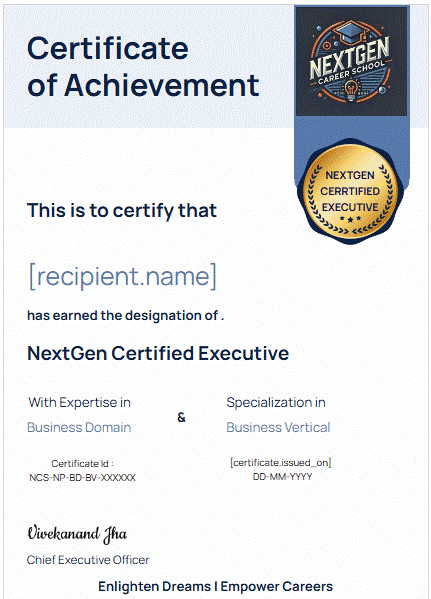
Elevate your resume with NextGen certification
Get Certified as a Business Executive
Become a NextGen Certified Business Executive and join an exclusive network of successful professionals who have completed the Mastering in Data Analytics program at NextGen Career School.
Start immediately by enrolling through our simple online application process.
Frequently Asked Questions
The Mastering in Data Analytics program is a comprehensive course designed to equip students with the skills and knowledge needed to analyze data effectively. The program covers key concepts in data manipulation, statistical analysis, and visualization techniques using industry-standard tools like Python, SQL, and Tableau. It prepares students to derive actionable insights from data to support decision-making in various organizational contexts.
— In-Demand Skills: Gain expertise in high-demand analytics tools and techniques.
— Hands-On Experience: Work on real-world projects that provide practical skills applicable in the workplace.
— Career Advancement: Enhance your employability and earning potential in data-driven roles.
— Comprehensive Curriculum: Learn essential topics, including data cleaning, visualization, and predictive analytics.
— Expert Guidance: Benefit from mentorship and support from industry professionals throughout the course.
The program is structured into several modules, each focusing on specific aspects of data analytics. Each module includes lectures, hands-on labs, and project work, culminating in a capstone project where students apply their learning to a real-world problem. The entire course is designed to be completed over a designated period, with a combination of live sessions and self-paced learning.
Graduates of the Mastering in Data Analytics program can pursue various career paths, including Data Analyst, Business Intelligence (BI) Analyst, Data Scientist, Marketing Analyst, Operations Analyst, Financial Analyst, Product Analyst. These roles are in high demand across various industries, including finance, healthcare, marketing, and technology.
The program is open to recent graduates, professionals seeking to upskill, and anyone interested in a career in data analytics. A background in mathematics, statistics, or a related field is beneficial but not mandatory. Basic computer literacy and familiarity with spreadsheets are recommended.
To earn the Mastering in Data Analytics certificate, students must complete all modules and assignments, participate in live sessions, and successfully complete the capstone project. A minimum passing grade in all assessments is required to qualify for the certificate.
Yes, placement services are available for graduates of the program. These services include resume building, interview preparation, and access to job opportunities through partnerships with companies seeking data analytics professionals. The placement team provides ongoing support to help students successfully transition into their desired career paths.
You may also like
Mastering in Business Analytics
Equip professionals with the skills to leverage data for strategic business decisions, driving growth, efficiency, and competitive advantage.
Mastering in Data Visualization
Equip professionals with the skills to turn complex data into impactful visuals, enabling clearer insights and smarter business decisions.
Mastering in Robotic Process Automation
Equip professionals with skills to automate tasks, streamline processes, and boost operational efficiency using RPA technologies.
One-to-One Online Consultation
Tailored Guidance for Your Success
Get personalized, one-to-one online consultations for Career Guidance, Employment Guidance, Admission Guidance with our expert advisors. Receive tailored guidance and actionable insights to achieve your goals.