Mastering in Business Analytics
Empowering Decisions Through Data-Driven Insights
n today’s data-driven world, mastering Business Analytics is essential for making informed decisions and driving strategic success. Our Mastering in Business Analytics course is thoughtfully designed to equip students with the essential skills needed to thrive in this fast-evolving field. Targeted at recent graduates and professionals alike, this program focuses on practical applications, providing hands-on experience with industry-leading tools such as Python, R, and Tableau. Through interactive projects and personalized mentorship, you’ll learn to analyze complex datasets, uncover trends, and create actionable insights that influence business outcomes. Unlock the power of analytics, enhance your career prospects, and position yourself as a pivotal contributor in the realm of data-driven decision-making. Join us and become a catalyst for change in your organization, ready to navigate the challenges and opportunities of the modern business landscape with confidence!
Course Duration
3 Months | 2 hours per day | 5 days a week
Course Fee
Rs. 54000/-
*50% at the time of admission & 50% after Internship Earnings or during certification.
Eligibility
undergraduates, Recent graduates, graduates and professionals.
Available Seats
30 Students
Course Advantage
Learning Outcomes
Graduates will be skilled at collecting, cleaning, and exploring complex datasets from various sources, effectively preparing them for analytics through foundational data handling and visualization techniques.
Students will gain expertise in applying statistical models and predictive analytics to identify trends and forecast outcomes, enhancing their ability to support strategic decisions with data-driven insights.
Graduates will be able to build, validate, and interpret machine learning models such as regression, classification, and clustering, enabling them to develop predictive and prescriptive solutions for real-world business challenges.
Students will learn to use prescriptive analytics and optimization techniques, such as linear programming and simulation, to make recommendations and optimize business processes.
Learners will become proficient in data storytelling and visualization, using advanced tools to create impactful, clear, and actionable reports and dashboards tailored to business stakeholders’ needs.
Graduates will understand the ethical considerations in analytics, including data privacy, governance, and regulatory compliance, ensuring that analytics practices meet legal and ethical standards.
Students will develop an awareness of the latest trends and technologies in analytics, such as cloud-based analytics, AI, and augmented analytics, making them adaptable to industry advancements and future-ready in the evolving analytics landscape.
Reasons to Enroll
Business Analytics skills are increasingly sought after by employers worldwide, making this course an opportunity to gain expertise in a field with high job demand and growth potential.
The course covers a full spectrum of analytics topics—from foundational statistics to advanced machine learning—ensuring students gain a well-rounded education in analytics and its applications.
Through real-world case studies, projects, and hands-on assignments, students acquire experience directly applicable to workplace scenarios, preparing them for immediate job readiness.
Business Analytics skills are valuable across various industries such as finance, healthcare, retail, and tech, enabling graduates to explore diverse career paths and roles in analytics, data science, and business intelligence.
The course introduces industry-standard tools like Python, R, SQL, Power BI, and Tableau, equipping students with practical knowledge of the technologies and methods employers are looking for.
With a focus on ethical data use and compliance, students learn the critical aspects of handling data responsibly—skills that are essential and valued in today’s privacy-focused business environment.
Designed with a job-focused approach, the course prepares students for analytics roles both in the global job market and in their local economies, with competitive skills that make them stand out to employers worldwide.
Career Opportunities & Pathways
Business Analysts use data to solve business problems, identify trends, and make strategic recommendations to optimize business performance. This role involves data analysis, forecasting, and communicating insights to stakeholders.
Data Analysts interpret complex datasets to produce actionable insights, focusing on data cleaning, visualization, and reporting. They work closely with various teams to help guide decision-making across business functions.
Data Scientists utilize statistical and machine learning techniques to build predictive models, focusing on big data and advanced analytics to solve complex business challenges and create data-driven solutions.
Financial Analysts apply business analytics in finance, using data models to forecast revenue, evaluate risks, and make recommendations for financial planning, budgeting, and investment decisions.
Marketing Analysts analyze consumer behavior, market trends, and campaign performance. They leverage data analytics to optimize marketing strategies, customer segmentation, and brand positioning.
Operations Analysts focus on process improvement, resource allocation, and productivity. They use analytics to optimize supply chain, logistics, and manufacturing processes, driving operational efficiency.
Product Analysts use data to assess product performance, inform product development, and optimize the user experience. They analyze usage patterns and customer feedback to support product strategy and innovation.
Curriculum
Establishes a strong understanding of core concepts, the role of Business Analytics in organizations, and key tools.
— Introduction to Business Analytics: Definition, Scope, and Applications
— The Role of Business Analysts: Skills and Responsibilities
— Business Analytics vs. Business Intelligence: Key Differences
— Overview of Analytics Tools: R, Python, SQL, and Excel
— Analytical Thinking: Problem-Solving Frameworks for Analysts
— Data Types and Sources in Analytics
— Building a Data-Driven Culture: Importance in Modern Business
— Translating Business Problems into Analytical Questions
— Real-World Examples of Business Analytics in Various Industries
Focuses on foundational data handling skills, preparing students to work with diverse data types and sources.
— Data Collection and Extraction Techniques: Web Scraping, APIs, and Databases
— Data Cleaning and Preparation: Techniques to Improve Data Quality
— Data Exploration: Identifying Trends, Patterns, and Anomalies
— Exploratory Data Analysis (EDA) Techniques
— Working with Structured and Unstructured Data
— SQL for Data Analytics: Queries, Joins, and Aggregations
— Data Aggregation and Summarization
— Data Sampling and Variable Selection
— Data Visualization for EDA: Identifying Key Insights Early
Covers essential statistical and mathematical concepts applied in Business Analytics.
— Descriptive Statistics: Measures of Central Tendency and Dispersion
— Probability Basics: Concepts and Applications in Analytics
— Inferential Statistics: Hypothesis Testing and Confidence Intervals
— Correlation and Causation: Identifying Relationships in Data
— Linear Algebra for Data Analytics: Vectors, Matrices, and Transformations
— Regression Analysis: Linear and Logistic Regression
— Multivariate Analysis: Techniques for Handling Complex Data
— Understanding Distributions: Normal, Binomial, Poisson, etc.
— Real-World Applications of Statistics in Business Analytics
Introduces predictive modeling techniques and prepares students for data-driven forecasting.
— Introduction to Predictive Analytics: Goals and Applications
— Building and Interpreting Regression Models
— Time Series Analysis: Trend Analysis and Forecasting Techniques
— Classification Techniques: Decision Trees, k-Nearest Neighbors
— Ensemble Methods: Boosting, Bagging, and Random Forests
— Model Evaluation: Metrics like RMSE, MAE, Accuracy, Precision, Recall
— Cross-Validation Techniques: Ensuring Model Reliability
— Building Predictive Models with Python/R
— Real-World Predictive Analytics Applications: Use Cases
Focuses on machine learning and data mining techniques for deeper insights and automation.
— Introduction to Machine Learning in Business Analytics
— Supervised vs. Unsupervised Learning
— Clustering Techniques: k-Means, Hierarchical Clustering, DBSCAN
— Neural Networks and Deep Learning Basics
— Text Mining and Natural Language Processing (NLP)
— Sentiment Analysis for Social Media and Customer Feedback
— Anomaly Detection Techniques for Fraud Detection
— Model Optimization Techniques: Hyperparameter Tuning
— Case Studies in Machine Learning for Business Analytics
Teaches methods for recommendation systems, optimization, and simulation to guide decision-making.
— Introduction to Prescriptive Analytics: Goals and Value
— Optimization Techniques: Linear and Non-Linear Programming
— Simulation Modeling: Monte Carlo and What-If Analysis
— Building Recommendation Systems: Collaborative Filtering, Content-Based
— Scenario Analysis for Business Decision Support
— Network Analysis: Applying Graph Theory in Business Contexts
— Operational Research in Business Analytics: Inventory, Queue, Resource Management
— Optimization with Constraints: Budget, Resource, and Time Constraints
— Case Studies on Prescriptive Analytics in Supply Chain, Finance, and Ma
Prepares students for real-world applications, ethics, and future trends.
— Data Storytelling: Communicating Insights Effectively
— Designing Reports and Dashboards for Decision-Makers
— Data Presentation Skills: Simplifying Complex Information
— Ethical Considerations in Business Analytics: Privacy, Bias, Fairness
— Data Governance and Regulatory Compliance: GDPR, CCPA, HIPAA
— Data Security: Safeguarding Sensitive Information
— Cloud Analytics: Big Data Solutions in the Cloud (AWS, Azure, Google Cloud)
— Emerging Trends in Analytics: AI, IoT, Edge Analytics, and Augmented Analytics
— Final Project: Capstone Analysis on a Real-World Dataset
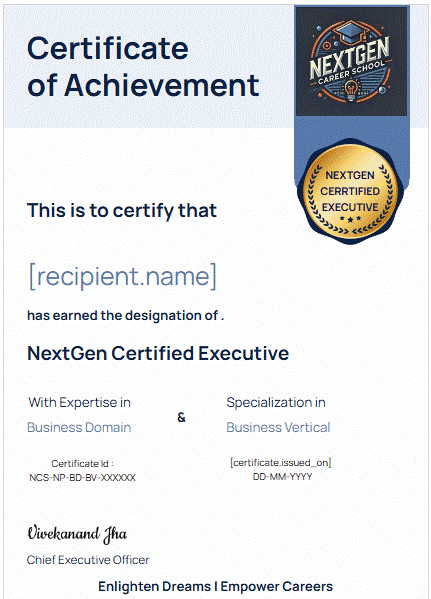
Certification
Elevate your resume with NextGen certification
Get Certified as a Business Executive
Become a NextGen Certified Business Executive and join an exclusive network of successful professionals who have completed the Mastering in Business Analytics program at NextGen Career School.
Start immediately by enrolling through our simple online application process.
Frequently Asked Questions
The Mastering in Business Analytics program is a comprehensive course designed to equip students with the skills needed to analyze data, uncover insights, and make data-driven decisions. It covers key topics such as data preparation, statistical analysis, predictive modeling, and data visualization, using industry-standard tools and techniques.
This program offers several benefits, including:
— In-demand Skills: Acquire essential skills that are highly sought after in the job market.
— Hands-on Experience: Gain practical experience with leading analytics tools like Python, R, and Tableau.
— Career Advancement: Enhance your career prospects in various industries by mastering data analytics.
— Expert Guidance: Benefit from personalized mentorship from industry professionals.
— Real-World Applications: Work on projects that address real business challenges, preparing you for immediate workplace success.
The program is structured into seven modules, each comprising nine classes. It covers foundational concepts, advanced analytics techniques, data visualization, and ethical considerations in analytics. The curriculum includes hands-on projects, case studies, and assessments to reinforce learning.
Graduates of the program can pursue various career opportunities, including roles such as Business Analyst, Data Analyst, Data Scientist, Financial Analyst, Marketing Analyst, Operations Analyst, and Product Analyst. The skills gained also allow for advancement to positions like Analytics Manager or Chief Data Officer.
The program is designed for recent graduates and professionals looking to enhance their analytical skills. A basic understanding of statistics and data handling is beneficial but not mandatory. The program is suitable for individuals from diverse backgrounds, including business, finance, marketing, and technology.
To earn the certificate, students must complete all modules and classes, successfully participate in hands-on projects, and pass the assessments. Active engagement in class discussions and mentorship sessions is also encouraged to maximize learning outcomes.
Yes, we offer placement support services to help graduates secure job opportunities in the analytics field. This includes resume building, interview preparation, and access to job listings and networking opportunities with industry partners.
You may also like
Mastering in Data Analytics
Empower professionals to analyze data, uncover insights, and drive data-driven decisions for business optimization.
Mastering in Data Visualization
Equip professionals with the skills to turn complex data into impactful visuals, enabling clearer insights and smarter business decisions.
Mastering in Business Process Analysis
Equip professionals with skills to analyze and optimize business processes for greater efficiency and decision-making.
One-to-One Online Consultation
Tailored Guidance for Your Success
Get personalized, one-to-one online consultations for Career Guidance, Employment Guidance, Admission Guidance with our expert advisors. Receive tailored guidance and actionable insights to achieve your goals.