Mastering in Production & Operations
Your Path to Operational Excellence
In today’s rapidly evolving industrial landscape, effective management of production and operations is essential for organizational success. Our Mastering in Production & Operations course is designed to equip students with the critical skills and knowledge needed to streamline production processes, improve operational efficiency, and lead teams with confidence. Tailored for recent graduates and undergraduates, this course covers key areas such as supply chain management, production planning, quality control, and the latest technologies like Industry 4.0 and automation.
With a strong emphasis on practical, real-world applications, students will engage in hands-on learning to develop the expertise required to enhance productivity, optimize resources, and drive continuous improvement. This program prepares you for immediate job placement in local and global production and operations roles, ensuring you are equipped to thrive in the competitive industrial environment.
Course Duration
3 Months | 2 hours per day | 5 days a week
Course Fee
Rs. 45000/-
*50% at the time of admission & 50% after Internship Earnings or during certification.
Eligibility
undergraduates, Recent graduates, graduates and professionals.
Available Seats
30 Students
Course Advantage
Learning Outcomes
Demonstrate a comprehensive understanding of various production systems (job, batch, mass, and continuous) and their applications in real-world settings.
Analyze and implement effective supply chain and logistics strategies, focusing on inventory management, procurement, and distribution to enhance operational efficiency.
Develop and apply production planning and control techniques, including Master Production Scheduling (MPS) and Material Requirements Planning (MRP), to ensure timely and cost-effective production.
Utilize quality management tools and techniques, such as Six Sigma and Total Quality Management (TQM), to identify and eliminate defects in production processes and improve overall quality.
Assess the impact of emerging technologies, such as IoT and automation, on production processes and apply these technologies to enhance operational performance.
Cultivate leadership and people management skills to effectively motivate and manage production teams, fostering a collaborative and productive work environment.
Evaluate and implement sustainable manufacturing practices that minimize environmental impact, promote energy efficiency, and support corporate social responsibility initiatives within operations.
Reasons to Enroll
The course covers essential topics in production and operations management, providing a well-rounded education that prepares you for various roles in the industry.
ngage in hands-on projects, real-world case studies, and simulations that enhance your understanding of production processes and operational strategies, making you job-ready.
Gain in-demand skills such as supply chain management, quality control, and the use of advanced technologies like automation and IoT, ensuring you are competitive in the job market.
Learn from experienced faculty members and industry professionals who bring real-world insights and best practices into the classroom, enhancing your learning experience.
Participate in group projects and discussions with peers from diverse backgrounds, fostering teamwork and collaboration skills that are essential in the production and operations field.
Learn about sustainable manufacturing practices and corporate social responsibility, positioning yourself as a forward-thinking professional committed to positive environmental impact in the industry.
Benefit from dedicated career services and job placement assistance, helping you secure immediate employment in production and operations roles upon graduation.
Career Opportunities & Pathways
Responsible for overseeing daily operations, improving processes, and ensuring production efficiency. This role involves planning, organizing, and coordinating production activities to meet business goals.
Focuses on analyzing and optimizing supply chain processes, including inventory, procurement, and distribution. Supply chain analysts use data-driven insights to enhance efficiency and reduce costs.
Develops and implements production schedules to ensure timely manufacturing and delivery of products. Production planners balance inventory, labor, and resources to meet demand forecasts.
Manages quality control systems and ensures products meet company and regulatory standards. QA managers also lead continuous improvement initiatives to enhance product quality and operational excellence.
Coordinates and manages the movement of goods, from suppliers to end consumers. This role involves planning distribution, managing warehousing, and optimizing transportation to ensure timely deliveries.
Implements and manages automation systems in production facilities, enhancing efficiency and reducing labor costs. This role requires expertise in robotics, IoT, and other advanced technologies.
Focuses on integrating sustainable practices into production and operations. Sustainability coordinators develop strategies for waste reduction, energy efficiency, and environmental compliance to align with corporate social responsibility goals.
Curriculum
— Overview of Production & Operations Management
— Types of Production Systems (Job, Batch, Mass, and Continuous)
— Role of Operations Management in Organizations
— Operations Strategy and Competitive Advantage
— Process Design and Analysis
— Capacity Planning and Management
— Location Strategy and Facility Layout
— Lean Manufacturing Principles
— Quality Management & Six Sigma Introduction
— Introduction to Supply Chain Management
— Inventory Management and Control Techniques
— Procurement and Vendor Management
— Logistics and Distribution Strategies
— Warehouse Management and Operations
— Demand Forecasting and Planning
— International Supply Chain and Trade Compliance
— Risk Management in Supply Chain
— Supply Chain Optimization and Technologies
— Introduction to Production Planning & Scheduling
— Master Production Schedule (MPS) Development
— Material Requirements Planning (MRP)
— Capacity Requirement Planning (CRP)
— Just-In-Time (JIT) and Kanban Systems
— Aggregate Planning Techniques
— Shop Floor Control and Tracking
— Maintenance Management and Total Productive Maintenance (TPM)
— Production Performance Metrics (KPIs, OEE)
— Introduction to Industry 4.0 and Smart Manufacturing
— Automation in Production Processes
— Robotics in Operations and Manufacturing
— Internet of Things (IoT) in Manufacturing
— Artificial Intelligence and Machine Learning in Operations
— Data-Driven Decision-Making in Operations
— Computer-Aided Design (CAD) & Computer-Aided Manufacturing (CAM)
— Cybersecurity in Operations
— Future Trends in Operations Technology
— Quality Management Systems (QMS) Overview
— Introduction to Six Sigma & DMAIC Process
— Total Quality Management (TQM) Principles
— Statistical Process Control (SPC)
— Root Cause Analysis and Problem-Solving Techniques
— ISO Standards and Certifications
— Kaizen and Continuous Improvement Techniques
— Implementing 5S in Operations
Case Studies on Successful Continuous Improvement Projects
— Leadership Styles in Production and Operations
— Managing and Motivating Production Teams
— Conflict Resolution and Team Dynamics
— Workforce Planning and Scheduling
— Training and Development in Operations
— Safety and Compliance in Operations
— Managing Change in Production Processes
— Negotiation Skills for Operations Managers
— Ethical Leadership in Operations
— Global Production Strategies and Market Expansion
— Cross-Cultural Operations Management
— Outsourcing and Offshoring in Production
— Sustainable Manufacturing Practices
— Environmental Impact and Waste Reduction
— Corporate Social Responsibility (CSR) in Operations
— Energy Management and Efficiency in Production
— Circular Economy and Zero Waste Concepts
— Future of Global Operations and Sustainability
Certification
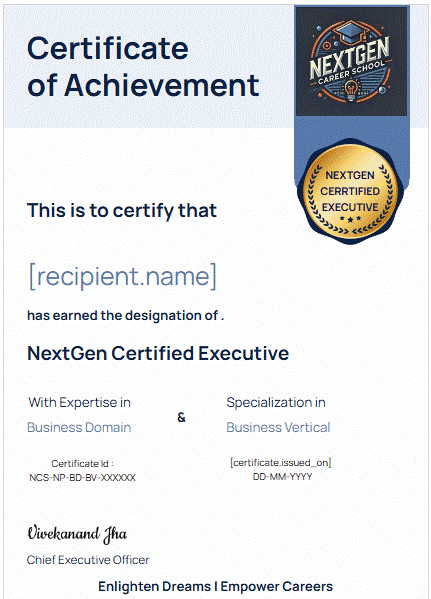
Elevate your resume with NextGen certification
Get Certified as a Business Executive
Become a NextGen Certified Business Executive and join an exclusive network of successful professionals who have completed the Mastering in Production & Operations program at NextGen Career School.
Start immediately by enrolling through our simple online application process.
Frequently Asked Questions
The Mastering in Production & Operations program is designed to equip students with essential knowledge and skills in production processes, operations management, and supply chain strategies, preparing them for various roles in the industry.
Key benefits include a comprehensive curriculum, practical learning experiences, industry-relevant skills, expert instruction, and job placement support, all aimed at ensuring you are ready for immediate employment in production and operations roles.
The program consists of 7 modules, each with 9 classes, covering a wide range of topics in production and operations management, including production planning, quality control, and emerging technologies.
After completing the course, students can pursue specializations in areas such as Inventory and warehouse Management, Supply Chain Management and Quality Management & six sigma for enhancing their expertise in specific fields within production and operations.
The program is open to recent graduates and undergraduates from various educational backgrounds, particularly those interested in pursuing a career in production and operations management.
To earn the certificate, students must complete all course classes, participate in the internship, and successfully pass any assessments or evaluations.
Yes, dedicated career services are available, offering job placement assistance, resume building, interview preparation, and networking opportunities to help graduates secure positions in the industry.
Focused Specialization Programs
Mastering in Inventory & Warehouse Management
Equip professionals to optimize inventory, streamline warehouse operations, and boost supply chain efficiency
Mastering in Supply Chain Management
Equip professionals with skills to optimize supply chain processes, enhance efficiency, and manage logistics for business success.
Matering in Quality Management and Six Sigma
Equip professionals with skills to implement quality systems and Six Sigma, driving process improvement and excellence.
One-to-One Online Consultation
Tailored Guidance for Your Success
Get personalized, one-to-one online consultations for Career Guidance, Employment Guidance, Admission Guidance with our expert advisors. Receive tailored guidance and actionable insights to achieve your goals.