Mastering in Finance & Accounting
Your Gateway to Financial Expertise
Course Duration
3 Months | 2 hours per day | 5 days a week
Course Fee
Rs. 45000/-
*50% at the time of admission & 50% after Internship Earnings or during certification.
Eligibility
undergraduates, Recent graduates, graduates and professionals.
Available Seats
30 Students
Course Advantage
Learning Outcomes
You will master the principles of financial and managerial accounting, including the preparation and interpretation of financial statements, cost management, and budgeting techniques.
Gain hands-on experience with industry-standard accounting software like QuickBooks, Swastik, Tally, and ERP systems, enabling you to automate financial processes and enhance reporting accuracy.
Learn to apply advanced financial analysis techniques, such as ratio analysis, break-even analysis, and capital budgeting, to make informed business decisions.
Understand the fundamentals of corporate taxation, VAT accounting, and payroll taxes, while gaining the ability to file tax returns and ensure regulatory compliance using computerized tools.
Develop the ability to generate and analyze consolidated financial statements, ensuring compliance with GAAP and IFRS standards, and effectively communicate financial results to stakeholders.
Acquire the knowledge to evaluate financial risks, perform investment analysis, and manage diversified portfolios, using financial tools to optimize asset allocation and return on investment.
Learn how to use Excel and other financial software for creating forecasts, managing cash flow, and preparing comprehensive budgets that support long-term financial planning.
Reasons to Enroll
Learn and practice with popular financial software like QuickBooks, Swastik, Tally, and Excel, equipping you with the skills that are highly demanded by employers in today’s digital economy.
Gain a solid foundation in both financial and managerial accounting, corporate finance, taxation, and financial reporting, ensuring you are well-rounded and prepared for any financial role.
Develop critical skills in financial analysis, budgeting, and risk management, giving you the competitive edge in the job market and making you a valuable asset to any organization.
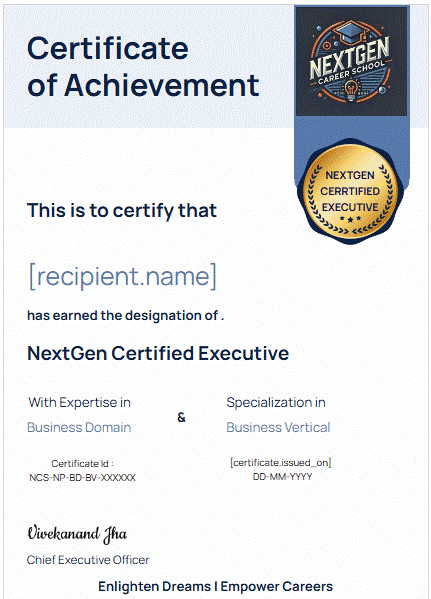
Earn a NextGen Certified Executive certification in Finance & Accounting upon completion, boosting your resume with industry-recognized credentials that showcase your expertise.
Work on real-world case studies that replicate the challenges faced in financial management, allowing you to apply what you learn directly to practical situations.
Equip yourself with the knowledge and skills necessary to pursue leadership roles in finance, accounting, and business management, preparing you for a career as a accountant, financial analyst.
Benefit from expert instructors with years of experience in the field, guiding you through complex topics and offering personalized feedback to ensure you master each concept.
Career Opportunities & Pathways
Analyze financial data, prepare financial reports, and provide insights to guide investment and business decisions. Financial analysts play a key role in assessing a company’s performance and developing data-driven strategies.
Manage day-to-day accounting tasks, such as recording transactions, preparing financial statements, and ensuring accurate reporting. Accountants are essential in maintaining compliance with accounting standards and helping businesses make sound financial decisions.
Develop, analyze, and monitor budgets to ensure financial efficiency within organizations. Budget analysts assess expenditure patterns, forecast future needs, and provide solutions to maximize resources effectively.
Review an organization’s financial records, operations, and internal controls to ensure accuracy and compliance with regulations. Internal auditors provide critical insights that help mitigate risks and enhance operational efficiency.
Assist clients with financial services like mergers, acquisitions, and initial public offerings (IPOs). Investment bankers evaluate investment opportunities, advise on risk and returns, and structure deals to maximize profitability for clients.
Oversee an organization’s financial operations, including budgeting, reporting, and regulatory compliance. Financial controllers are instrumental in ensuring financial stability and are responsible for implementing financial policies and monitoring cash flow.
Advise individuals and businesses on tax-related matters, including tax planning, filing, and compliance. Tax consultants help clients optimize tax liabilities while staying within regulatory guidelines, making them highly valuable in both local and international markets.
Curriculum
— Introduction to Financial Accounting
— Accounting Principles & Standards (GAAP, IFRS)
— Double-Entry Bookkeeping System
— Recording Transactions and Journal Entries
— Trial Balance Preparation
— Adjustments & Finalizing Accounts
— Financial Statements (Income Statement, Balance Sheet, Cash Flow)
— Accrual vs. Cash Accounting
— Computerized Component:
- — Introduction to Accounting Software (Swastik, Tally/QuickBooks)
- — Practical sessions on entering transactions and generating financial reports in accounting software
— Introduction to Managerial Accounting
— Cost Accounting Fundamentals
— Break-even Analysis & Marginal Costing
— Budgeting & Forecasting Techniques
— Cost-Volume-Profit (CVP) Analysis
— Variance Analysis (Material, Labor, Overhead)
— Activity-Based Costing (ABC)
— Computerized Component:
- — Budget preparation using Excel (with functions like Pivot Tables, Charts, and Forecasting)
- — Cost analysis using accounting software
— Time Value of Money (Present & Future Value)
— Capital Budgeting (NPV, IRR, Payback Period)
— Financing Decisions – Debt vs. Equity
— Working Capital Management
— Financial Ratio Analysis (Liquidity, Profitability, Solvency)
— Dividend Policy and Capital Structure Theories
— Sources of Finance (Loans, Bonds, Shares)
— Computerized Component:
- — Using Excel for financial modeling, TVM calculations, and ratio analysis
- — Creating financial forecasts and assessing financing options using tools like QuickBooks or Swastik, Tally
— Introduction to Corporate and Income Tax
— Tax Planning and Compliance Strategies
— VAT Accounting
— Payroll Taxes and Employee Benefits
— Filing Tax Returns – Corporate and Individual Tax
— Anti-Money Laundering (AML) Compliance
— International Taxation Basics (Transfer Pricing, Double Taxation)
— Computerized Component:
- — VAT, and Payroll tax calculations using Swastik ,Tally/QuickBooks
- — Practical case studies on e-filing tax returns and generating tax reports using accounting software
— Understanding Financial Reporting Standards (GAAP, IFRS)
— Consolidated Financial Statements
— Cash Flow Statement (Direct and Indirect Methods)
— Ratio Analysis (Profitability, Efficiency, Liquidity)
— Vertical and Horizontal Analysis of Financial Statements
— Financial Reporting for Investors and Stakeholders
— Computerized Component:
- — Financial statement preparation and analysis using Excel and accounting software
- — Generating consolidated reports and financial statements automatically in QuickBooks or Swastik, Tally
— Introduction to Enterprise Resource Planning (ERP) Systems in Finance
— Managing Accounts Payable and Accounts Receivable
— Bank Reconciliation and Cash Flow Monitoring
— Automating Financial Processes with ERP Systems
— Budgeting and Forecasting in ERP systems
— Risk Management and Internal Controls within ERP
— Computerized Component:
- — Hands-on training with ERP systems for financial management
- — Practical exercises on automating financial reporting, inventory management, and payroll processing
— Types of Investments (Stocks, Bonds, Mutual Funds)
— Risk-Return Analysis
— Capital Asset Pricing Model (CAPM)
— Portfolio Diversification and Asset Allocation
— Equity Valuation (EPS, P/E Ratios)
— Investment Strategies (Value, Growth, Income Investing)
— Behavioral Finance Concepts
— Computerized Component:
- — Using Excel and financial tools for investment analysis and portfolio management
- — Stock market simulations and portfolio performance tracking using software tools
Certification
Elevate your resume with NextGen certification
Get Certified as a Business Executive
Become a NextGen Certified Business Executive and join an exclusive network of successful professionals who have completed the Mastering in Finance & Accounting program at NextGen Career School.
Start immediately by enrolling through our simple online application process.
Frequently Asked Questions
The Mastering in Finance & Accounting course is a comprehensive program designed to provide students with a deep understanding of financial principles, accounting practices, and the use of computerized financial systems. The course covers essential topics like financial reporting, managerial accounting, taxation, and investment management, equipping students with the skills needed for various finance-related roles.
Key benefits of the program include:
— Mastery of essential finance and accounting concepts and practices.
— Hands-on experience with industry-standard software like QuickBooks, Swastik, Tally, and Excel.
— Enhanced analytical and decision-making skills through practical projects.
— Preparation for diverse career opportunities in finance, accounting, and business management.
— Earning a NextGen Certified Executive certification to boost your resume.
The course is structured into 7 modules, each focusing on specific areas such as financial accounting, managerial accounting, corporate finance, taxation, and financial reporting. Each module includes theoretical lessons, practical applications, and real-world case studies to reinforce learning.
After completing the course, students can pursue specializations in areas such as Corporate Finance Management, Taxation and Compliance, Financial Analysis and Reporting. These specializations will allow you to deepen your expertise in specific finance and accounting fields.
The program is open to recent graduates, undergraduates, and professionals seeking to enhance their finance and accounting skills. No prior experience in finance or accounting is required, making it suitable for beginners as well.
To earn the NextGen Certified Executive certification in Finance & Accounting, students must complete all course modules, pass online assessments, and submit a final project that demonstrates their proficiency in applying financial principles and accounting practices.
Yes, the program includes access to NextGen Career School’s placement cell, which provides job assistance, internship opportunities, and connections with employers seeking finance and accounting professionals.
Focused Specialization Programs
Mastering in Corporate Finance Management
Equip professionals with skills to optimize financial strategies, manage investments, and enhance organizational growth
Matering in Taxation and Compliance
Equip professionals with skills to navigate tax regulations, ensure compliance, and implement effective tax planning strategies
Mastering in Financial Analysis and Reporting
Equip professionals with skills to analyze financial data, interpret reports, and provide insights to drive informed business decisions.
One-to-One Online Consultation
Tailored Guidance for Your Success
Get personalized, one-to-one online consultations for Career Guidance, Employment Guidance, Admission Guidance with our expert advisors. Receive tailored guidance and actionable insights to achieve your goals.