Mastering in Business Automation
Empowering the Future of Efficient Operations
In today’s fast-paced and ever-evolving business world, mastering the art of automation is essential for anyone aiming to streamline operations and drive organizational success. Our Mastering in Business Automation course is meticulously designed to equip students with the fundamental skills and knowledge required to thrive in roles focused on business process automation. This course serves as a crucial step for recent graduates and undergraduates, enabling them to automate key business functions and enhance overall productivity. With a focus on practical application, this program ensures you gain hands-on experience in automating workflows and implementing the latest automation tools, positioning you to stand out in the competitive job market. Through real-world projects and expert mentorship, you’ll develop the agility to adapt automation strategies across various industries, giving you a competitive edge. Unlock the power of automation to drive impactful results and accelerate your career trajectory.
Course Duration
3 Months | 2 hours per day | 5 days a week
Course Fee
Rs. 45000/-
*50% at the time of admission & 50% after Internship Earnings or during certification.
Eligibility
undergraduates, Recent graduates, graduates and professionals.
Available Seats
30 Students
Course Advantage
Learning Outcomes
Gain a comprehensive understanding of the fundamental principles of business automation and its significance in enhancing operational efficiency.
Learn to analyze business processes and identify areas where automation can streamline workflows and reduce manual tasks.
Acquire practical skills in using various automation tools and technologies, including RPA, CRM, and ERP systems, to implement effective automation solutions.
Develop the ability to design, implement, and manage automated workflows that improve productivity across different business functions.
Learn techniques for monitoring and optimizing automated processes to ensure they deliver maximum efficiency and effectiveness.
Understand how to align automation initiatives with overall business strategy to drive growth and innovation.
ain the skills to assess the impact of automation on business performance, including measuring ROI and identifying areas for continuous improvement.
Reasons to Enroll
Equip yourself with automation skills that are highly sought after in today’s job market, giving you a competitive edge in various industries.
Gain practical, real-world experience by working with leading automation tools and technologies, preparing you for immediate application in the workplace.
Learn from industry professionals and experienced instructors who provide insights into best practices and the latest trends in business automation.
Benefit from a well-structured curriculum that covers essential topics, ensuring you develop a well-rounded understanding of automation across different business functions.
Develop the ability to solve real-world business challenges using automation, helping you apply your skills directly to workplace scenarios.
Enjoy a flexible learning environment that accommodates your schedule, allowing you to balance your studies with personal and professional commitments.
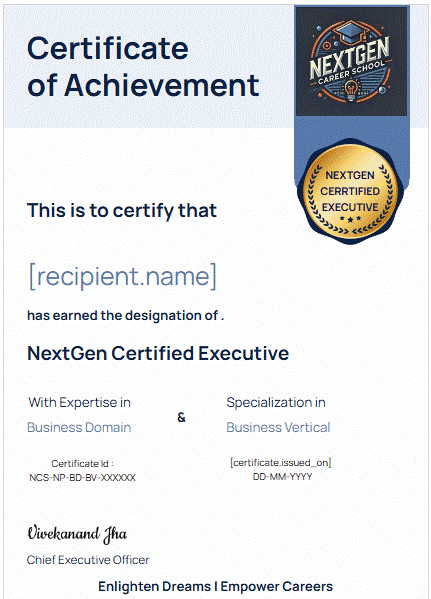
Enhance your resume with a recognized certification as a NextGen Certified Executive in Business Automation, validating your skills and commitment to professional development.
Career Opportunities & Pathways
Responsible for designing and implementing automated solutions within business workflows, an Automation Specialist optimizes repetitive tasks across departments, increasing operational efficiency and productivity.
This role involves developing and maintaining robotic process automation solutions using tools like UiPath and Automation Anywhere, enabling businesses to automate complex processes with high accuracy and reduced human involvement.
Focused on analyzing and redesigning workflows, a Business Process Analyst identifies opportunities for automation and process improvement, ensuring alignment with business goals and enhancing efficiency across teams.
This professional manages and automates customer relationship management systems (e.g., Salesforce, Zoho), enhancing customer interactions, streamlining sales processes, and improving customer retention through data-driven insights.
A Project Manager in digital transformation oversees the implementation of automation technologies within organizations, coordinating projects that improve digital infrastructure and drive strategic change for future growth.
This role involves using tools like Microsoft Power Automate and Zapier to automate data management tasks, such as data entry, reporting, and analytics, making data-driven decision-making more efficient and accessible for businesses.
Specializing in ERP systems like SAP and Oracle, ERP Automation Consultants integrate automation within enterprise processes, optimizing areas such as inventory management, finance, and supply chain to support streamlined business operations.
Curriculum
— Overview of business automation and its importance in today’s business landscape.
— Evolution and future trends in automation.
— Key areas where automation is applied: operations, finance, HR, marketing, and customer service.
— Benefits, challenges, and risks of automation.
— Case studies on successful automation strategies.
— Overview of popular automation tools (RPA, AI, CRM, ERP).
— Automation and digital transformation.
— Role of AI and machine learning in business automation.
— Real-life examples of automation in different industries.
— Introduction to business processes and workflows.
— Identifying processes suitable for automation.
— Tools for business process mapping (Lucidchart, Microsoft Visio).
— Analyzing and redesigning workflows for automation.
— Automation of repetitive tasks: what to automate and what not to.
— Documenting processes before and after automation.
— Role of data in process optimization and automation.
— Streamlining business processes for improved efficie
— Introduction to Robotic Process Automation (RPA) tools (UiPath, Automation Anywhere).
— CRM automation (Salesforce, Zoho) for sales and customer service.
— ERP systems (SAP, Oracle) for business integration and process automation.
— Automation of data management with Zapier, Microsoft Power Automate.
— Automating business reporting and analytics.
— Overview of AI tools for automating decision-making.
— Automation of back-office operations.
— Integration of automation tools with existing systems.
— Case studies on technology-driven automation.
— Automating recruitment, onboarding, payroll, and employee data management.
— Attendance tracking and scheduling automation.
— Employee self-service portals and automated HR workflows.
— Office management automation: task management, document processing, and communication.
— Automating performance evaluation and feedback processes.
— Tools for administrative automation (Trello, Asana, Slack).
— Handling legal compliance and reporting through automation.
— Reducing human error and increasing efficiency with automation.
— Case studies on HR and administrative automation.
— Automating invoicing, accounts payable/receivable, and budgeting.
— Tools for finance automation (QuickBooks, Xero).
— Real-time data integration for financial decision-making.
— Financial reporting automation: monthly, quarterly, and annual reports.
— Reducing manual data entry with automation.
— Compliance and auditing automation.
— Introduction to AI in financial forecasting and decision-making.
— Workflow automation in expense management and procurement.
— Case studies of successful finance automation implementations.
— Automating lead generation, sales funnels, and customer outreach.
— Tools for marketing automation (Mailchimp, HubSpot).
— CRM automation for sales and customer relationship management.
— Social media automation tools for brand engagement and analytics.
— Automating customer support: chatbots, automated responses, and helpdesk systems.
— Personalized marketing automation with AI.
— Automating customer feedback and service improvement processes.
— Integration of sales, marketing, and customer service automation.
— Case studies on how businesses scaled using automation in these areas.
— Planning and designing automation solutions for businesses.
— Steps to implement automation tools across business functions.
— Challenges in deploying and managing automation systems.
— Employee training and upskilling for working with automated systems.
— Monitoring and optimizing automated workflows for continuous improvement.
— Troubleshooting and maintaining automation tools and systems.
— Building an automation strategy that aligns with business goals.
— Measuring ROI on business automation projects.
— Case studies on managing business automation successfully.
Certification
Elevate your resume with NextGen certification
Get Certified as a Business Executive
Become a NextGen Certified Business Executive and join an exclusive network of successful professionals who have completed the Mastering in Business Automation program at NextGen Career School.
Start immediately by enrolling through our simple online application process.
Frequently Asked Questions
The Mastering in Business Automation program is designed to equip students with the essential skills and knowledge to automate business processes across various functions, enhancing operational efficiency and productivity.
Key benefits include hands-on experience with leading automation tools, practical knowledge of designing and implementing automated workflows, and a recognized certification that validates your expertise in business automation.
The program consists of 7 sub-modules, each containing 9 classes, totaling 63 classes over a duration of 3 months. It includes a blend of theoretical knowledge and practical applications through projects and case studies.
After completing the course, students can pursue specializations in areas such as Robotic Process Automation (RPA), Business Process Analysis and Automation Project Management depending on their career interests.
The program is open to recent graduates and undergraduates who are interested in pursuing a career in business automation, regardless of their academic background.
To earn the certificate, students must complete all course classes, participate in the internship, and successfully pass any assessments or evaluations.
Yes, NextGen Career School offers dedicated placement services to assist students in securing job opportunities in the field of business automation, including resume building and interview preparation.
Focused Specialization Programs
Mastering in Robotic Process Automation
Equip professionals with skills to automate tasks, streamline processes, and boost operational efficiency using RPA technologies.
Mastering in Business Process Analysis
Equip professionals with skills to analyze and optimize business processes for greater efficiency and decision-making.
Mastering in Automation Project Management
Equip professionals with skills to manage automation projects effectively, ensuring timely delivery and successful implementation.
One-to-One Online Consultation
Tailored Guidance for Your Success
Get personalized, one-to-one online consultations for Career Guidance, Employment Guidance, Admission Guidance with our expert advisors. Receive tailored guidance and actionable insights to achieve your goals.