Mastering in office Infrastructure Management
Building a Solid Framework for Operational Excellence
In today’s dynamic workplace, effective office infrastructure management is vital for ensuring seamless operations and enhancing productivity. Our Mastering in Office Infrastructure Management course is meticulously crafted to provide students with the core skills and insights needed to manage modern office environments successfully. This program serves as an essential foundation for aspiring office managers and executives, empowering them with the knowledge to optimize resources, streamline processes, and foster a collaborative workspace. Through practical applications and engaging projects, you will develop the expertise necessary to navigate the complexities of office infrastructure, ensuring you can contribute to your organization’s success from day one. Equip yourself with the tools to enhance operational efficiency and create a positive workplace culture that drives results.
Course Duration
3 Months | 2 hours per day | 5 days a week
Course Fee
Rs. 45000/-
*50% at the time of admission & 50% after Internship Earnings or during certification.
Eligibility
undergraduates, Recent graduates, graduates and professionals.
Available Seats
30 Students
Course Advantage
Learning Outcomes
Students will be able to define and explain the key components of office infrastructure, including physical space, technology, and human resources, and how they contribute to organizational efficiency.
Learners will demonstrate the ability to apply best practices in facilities management, including maintenance scheduling, vendor management, and compliance with health and safety regulations.
Students will gain proficiency in managing IT infrastructure, including networking, cybersecurity, and cloud computing, ensuring that office technology is reliable and secure.
Participants will be able to evaluate and implement effective communication systems, including telephony, video conferencing, and internal messaging tools, to enhance collaboration within the workplace.
Learners will develop project management skills relevant to office infrastructure initiatives, including planning, execution, budgeting, and performance measurement.
Students will understand procurement processes and vendor management techniques, enabling them to source office supplies and services effectively while negotiating favorable terms.
Participants will explore office automation tools and productivity software, applying strategies to enhance workflow efficiency and streamline repetitive tasks in the office environment.
Reasons to Enroll
Gain essential skills that are highly sought after in today’s job market, equipping you to meet the growing demand for office management professionals.
Benefit from a curriculum that emphasizes real-world applications, providing hands-on experience and practical insights to navigate complex office environments effectively.
Explore a wide range of topics, from facilities management and IT infrastructure to project management and procurement strategies, ensuring a well-rounded understanding of office infrastructure.
Enhance your qualifications and position yourself for career advancement in roles such as office manager, facilities coordinator, and operations supervisor.
Connect with industry professionals, fellow students, and instructors, building a valuable network that can lead to job opportunities and collaborations in the future.
Earn a certification that validates your expertise in office infrastructure management, adding credibility to your resume and distinguishing you from other candidates.
Enjoy a flexible learning environment that accommodates your schedule, allowing you to balance your studies with other commitments while pursuing your career goals.
Career Opportunities & Pathways
Oversee daily operations, manage office resources, and ensure a productive work environment, while also handling administrative tasks and staff coordination.
Responsible for managing office space, maintenance schedules, and vendor relationships, ensuring that facilities are well-maintained and compliant with safety standards.
Focus on managing and optimizing the organization’s IT systems, ensuring reliable technology support, cybersecurity measures, and effective data management.
Handle the procurement process for office supplies and services, negotiating contracts with vendors, and managing budgets to optimize costs while ensuring quality.
Oversee day-to-day office operations, implementing best practices to enhance productivity and efficiency, and ensuring that all office functions align with organizational goals.
Evaluate and optimize office operations and infrastructure, focusing on space utilization, resource allocation, and workflow processes. Identify areas for improvement, implement solutions that enhance productivity, and ensure the office environment supports organizational goals and employee well-being.
Lead office infrastructure projects, including office renovations, technology upgrades, and process improvements, utilizing project management methodologies to ensure successful execution.
Curriculum
— Overview of Office Infrastructure: Definition, Importance, and Components
— Types of Office Layouts and Their Benefits: Traditional, Open, Hybrid
— Understanding Office Equipment: Essential Tools and Technologies
— Office Space Planning and Design: Optimizing Productivity and Collaboration
— Managing Office Supplies and Inventory: Best Practices
— Safety and Ergonomics in the Workplace: Creating a Healthy Work Environment
— Technology Integration in Office Management: Trends and Innovations
— Office Infrastructure and Business Continuity Planning: Disaster Recovery
— Case Studies in Office Infrastructure Management: Real-World Applications
— Introduction to Facilities Management: Roles and Responsibilities
— Maintenance Management: Scheduling, Tracking, and Cost Control
— Energy Management: Sustainability Practices in Office Operations
— Vendor Management: Selecting and Negotiating with Suppliers
— Health and Safety Regulations: Compliance and Best Practices
— Crisis Management in Facilities: Emergency Preparedness and Response
— Managing Workspace Technology: AV Equipment, Security Systems, etc.
— Facilities Budgeting and Cost Management: Financial Planning
— Review and Q&A
— Overview of IT Infrastructure: Components and Significance
— Networking Basics: LAN, WAN, and Internet Connectivity
— Cloud Computing in Office Management: Benefits and Applications
— Cybersecurity Fundamentals: Protecting Office Infrastructure
— Backup and Data Recovery Solutions: Best Practices
— Software and Hardware Management: Asset Tracking and Maintenance
— Implementing Collaboration Tools: Enhancing Team Communication
— IT Support and Troubleshooting: Managing Technical Issues
— Review and Q&A
— Understanding Office Communication Systems: Types and Functions
— Telephony Systems: VoIP, PBX, and Modern Communication Tools
— Video Conferencing Tools: Best Practices for Remote Meetings
— Email Management Systems: Tools for Effective Communication
— Managing Internal Communication: Intranets and Collaboration Platforms
— Creating a Communication Policy: Guidelines for Effective Interactions
— Evaluating Communication Tools: Metrics for Success
— Case Studies in Office Communication Management
— Review and Q&A
— Introduction to Project Management Principles: Key Concepts and Phases
— Office Infrastructure Projects: Planning and Execution
— Project Scheduling and Time Management: Tools and Techniques
— Risk Management in Projects: Identifying and Mitigating Risks
— Budgeting for Office Projects: Estimating and Controlling Costs
— Performance Measurement and Evaluation: Metrics for Success
— Using Project Management Software: Overview and Applications
— Team Collaboration in Projects: Best Practices for Engagement
— Review and Q&A
— Understanding Procurement Processes: Steps and Strategies
— Developing Vendor Relationships: Building Partnerships
— Negotiation Techniques for Procurement: Achieving Win-Win Outcomes
— Evaluating Vendor Performance: Metrics and Reviews
— Sourcing Strategies: Cost-effective Approaches
— Contract Management: Key Components and Best Practices
— Sustainability in Procurement: Ethical and Eco-friendly Sourcing
— Case Studies in Procurement and Vendor Management
— Review and Q&A
— Overview of Office Automation: Benefits and Challenges
— Implementing Workflow Automation: Tools and Techniques
— Productivity Software: Using Microsoft Office Suite and Alternatives
— Task Management Systems: Organizing Workflows
— Time Tracking Tools: Maximizing Efficiency
— Data Management Tools: Managing Information Effectively
— Adopting New Technologies in the Office: Change Management Strategies
— Measuring Productivity Improvements: Key Performance Indicators
— Review and Q&A
Certification
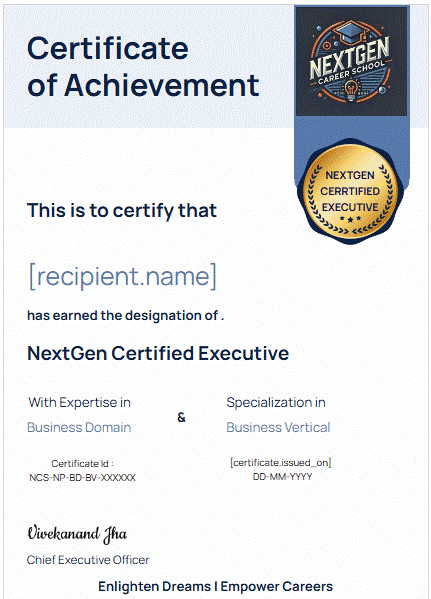
Elevate your resume with NextGen certification
Get Certified as a Business Executive
Become a NextGen Certified Business Executive and join an exclusive network of successful professionals who have completed the Mastering in office Infrastructure Management program at NextGen Career School.
Start immediately by enrolling through our simple online application process.
Frequently Asked Questions
The Mastering in Office Infrastructure Management program is designed to equip students with the essential skills and knowledge required to effectively manage and optimize office environments. The curriculum covers various aspects of office infrastructure, including facilities management, IT systems, project management, and communication tools, ensuring graduates are well-prepared to handle the complexities of modern office operations.
— Comprehensive Skill Development: Acquire a wide range of skills essential for managing office infrastructure effectively.
— Practical Experience: Engage in hands-on projects and real-world scenarios that enhance learning and application of concepts.
— Career Advancement: Position yourself for growth in a variety of office management roles, increasing your employability.
— Networking Opportunities: Connect with industry professionals and fellow students to build valuable relationships in the field.
— Certification: Receive a recognized certification that validates your expertise and enhances your resume.
The program consists of seven modules, each covering different aspects of office infrastructure management. Each module includes 9 classes, featuring interactive sessions, practical exercises, case studies, and assessments to reinforce learning. The curriculum is designed to be both theoretical and hands-on, ensuring students can apply what they learn in real-world settings.
Graduates can pursue a variety of career paths, including Office Manager, Facilities Coordinator, IT Infrastructure Manager, Project Manager, Procurement Specialist, Operations Supervisor and Business Analyst
The program is open to recent graduates, undergraduates, and professionals looking to enhance their skills in office management. A background in business administration, management, or related fields is advantageous but not mandatory.
To earn the certificate, students must successfully complete all modules and assessments, participate in practical projects, and achieve a passing grade in the program’s final evaluation. Active participation in class discussions and projects is also encouraged.
Yes, placement services are available for graduates of the program. The placement cell will assist students in finding job opportunities, providing career counseling, resume building, and interview preparation to help them secure positions in the field of office infrastructure management.
You may also like
Mastering in Digital Marketing Management
Equip professionals with digital strategies to boost online presence, drive engagement, conversion, and business growth.
Mastering Digital Office Management and Automation
Equip professionals to implement digital tools and automation for streamlined office processes and enhanced productivity.
Mastering in Business Automation
Equip professionals to leverage automation for optimized workflows, reduced manual tasks, and enhanced efficiency.
One-to-One Online Consultation
Tailored Guidance for Your Success
Get personalized, one-to-one online consultations for Career Guidance, Employment Guidance, Admission Guidance with our expert advisors. Receive tailored guidance and actionable insights to achieve your goals.