Students will grasp the basics of Business Process Automation (BPA), focusing on identifying tasks for automation and designing simple automated workflows to enhance operational efficiency.
Mastering in Business Process Analysis
Transforming Insights into Operational Excellence
In today’s dynamic business environment, the ability to analyze and optimize processes is critical for achieving operational excellence and sustaining competitive advantage. Our Mastering in Business Process Analysis course is expertly crafted to provide students with the essential skills and knowledge needed to dissect and enhance business workflows. This program serves as a vital stepping stone for recent graduates and undergraduates, empowering them to identify inefficiencies and implement strategic improvements across various business functions. Focusing on practical application, the course offers hands-on experience in process mapping, data analysis, and performance optimization, ensuring you are well-prepared to tackle real-world challenges. With guidance from industry experts and exposure to live projects, you will develop the analytical prowess needed to drive meaningful change in any organization. Unlock the potential of your analytical skills to achieve operational success and propel your professional growth!
Course Duration
3 Months | 2 hours per day | 5 days a week
Course Fee
Rs. 54000/-
*50% at the time of admission & 50% after Internship Earnings or during certification.
Eligibility
undergraduates, Recent graduates, graduates and professionals.
Available Seats
30 Students
Course Advantage
Learning Outcomes
Proficiency in Business Process Mapping and Workflow Design
Students will master techniques to create, document, and analyze process maps, identifying inefficiencies and designing streamlined workflows to enhance organizational operations.
Understanding and Application of Process Improvement Methodologies
Students will gain expertise in process improvement frameworks like Lean, Six Sigma, and Business Process Reengineering (BPR), enabling them to optimize processes across various business functions.
Fundamental Knowledge of Business Process Automation
Ability to Analyze and Use Data for Process Optimization
Students will learn to collect, analyze, and interpret data to make informed decisions about process improvements, using tools like Tableau and Power BI to track and visualize process performance.
Skill in Managing Change during Process Implementation
Students will acquire skills to handle the human and organizational aspects of process change, developing strategies to overcome resistance and successfully implement new workflows.
Capability to Design and Implement End-to-End Process Optimization Solutions
Through a capstone project, students will gain hands-on experience in analyzing, mapping, and optimizing a real-world business process, from initial assessment to the presentation of a full implementation plan.
Preparation for Immediate Employment in Process Analysis and Automation Roles
Equipped with practical, in-demand skills in business process analysis, automation, and optimization, students will be job-ready for roles such as Process Analyst, RPA Specialist, and Business Process Consultant in both global and local markets.
Reasons to Enroll
Career-Ready Skills in a High-Demand Field
Business process analysis and automation are rapidly growing fields, with companies seeking professionals who can enhance efficiency and reduce costs. This course prepares students with skills that are in demand across industries worldwide.
Hands-On Training with Real-World Tools and Methodologies
Students will gain practical experience using tools, process mapping software, and data visualization platforms, as well as applying methodologies like Lean and Six Sigma—making them ready to handle real-world challenges from day one.
Strong Foundation in Business Process Automation (BPA)
This course offers a solid grounding in Business Process Automation (BPA), equipping students with essential skills in automation technologies to prepare them for advanced roles and enhance their competitiveness in the job market.
Capstone Project for Practical Experience
The course’s capstone project gives students the chance to apply what they’ve learned to real-life business scenarios, from process analysis to optimization, building an impressive portfolio to showcase in job applications and interviews.
Broadened Career Options and Enhanced Employability
Graduates will be qualified for roles such as Business Process Analyst, Process Improvement Consultant, and Business Specialist. With these skills, students can pursue careers in consulting, finance, operations, HR, and IT in local and global markets.
Expert Instruction and Industry-Relevant Case Studies
The course offers guidance from experts, real-world examples, and case studies across various sectors, providing a comprehensive understanding of how successful process analysis impacts business operations and outcomes.
Future-Proof Skills Aligned with Digital Transformation
As businesses increasingly adopt digital transformation, students with expertise in process analysis, automation, and optimization will be at the forefront, making them invaluable assets to organizations seeking to remain competitive in a digital-first world.
Career Opportunities & Pathways
Business Process Analyst
Analyze, document, and redesign business processes for efficiency and effectiveness within organizations, making recommendations to improve operations across various departments.
Business Automation Specialist
Develop and implement automation strategies to enhance business processes, focusing on integrating technology solutions to improve workflow efficiency and reduce operational costs.
Process Improvement Consultant
Work as a consultant to analyze and optimize business processes for clients, often as part of a consulting firm or independently, using methodologies such as Lean Six Sigma to drive change.
Data Analyst with a Process Focus
Analyze process-related data to provide insights and recommendations for improvement, using data analytics tools to track efficiency metrics and process KPIs for informed decision-making.
Operations Manager
Manage day-to-day operations with a strong focus on process improvement, using skills in process mapping and analysis to optimize workflows and improve overall efficiency within teams.
Quality Assurance Analyst
Evaluate and ensure the quality of business processes by developing and monitoring metrics and standards, identifying areas for improvement, and collaborating with teams to implement quality enhancements.
Digital Transformation Specialist
Support digital transformation efforts by identifying and implementing automated and streamlined processes, aligning business operations with digital goals to enhance productivity and competitiveness.
Change Management Specialist
Facilitate the successful implementation of new processes and technologies, ensuring that employees are trained and supported throughout the transition to minimize resistance and maximize acceptance.
Curriculum
Module 1: Introduction to Business Process Analysis
— Key concepts in business process analysis.
Overview of common business processes in various sectors.
Roles and responsibilities of a business process analyst.
Process analysis frameworks: Lean, Six Sigma, and BPMN.
Introduction to key metrics for process analysis (KPIs, SLAs).
Basics of continuous improvement and process re-engineering.
Using case studies to analyze business processes.
Developing a process-centric approach to problem-solving.
Real-life examples of successful process analysis implementations.
Module 2: Business Process Mapping and Workflow Design
— Fundamentals of process mapping and its importance.
— Tools for creating process maps (Lucidchart, Microsoft Visio).
— Workflow design principles: simplicity, efficiency, and clarity.
— Identifying process bottlenecks and inefficiencies.
— Designing workflows to streamline operations.
— Documenting processes and setting standards.
— Mapping interdepartmental workflows for end-to-end visibility.
— Practical exercises in process mapping.
— Case studies in successful workflow redesign.
Module 3: Process Improvement Methodologies
— Overview of Lean principles and waste reduction.
— Six Sigma basics for improving process quality.
— Business Process Reengineering (BPR) and its applications.
— Applying Kaizen for continuous improvement.
— Process optimization strategies for different industries.
— Creating a process improvement plan.
— Identifying and minimizing process risks.
— Tools for monitoring and measuring process performance.
— Real-world applications and exercises using case studies.
Module 4: Business Process Automation Techniques
— Understanding the fundamentals of business process automation.
— Identifying tasks suitable for automation and process simplification.
— Introduction to automation frameworks and methodologies.
— Evaluating automation tools (e.g., workflow automation software).
— Implementing low-code/no-code automation solutions.
— Integrating automation within existing processes.
— Assessing the impact of automation on organizational efficiency.
— Practical exercises on creating automated workflows.
— Case studies showcasing successful automation projects.
Module 5: Data Analysis for Business Process Optimization
— Role of data in process analysis and decision-making.
— Basics of data collection, cleaning, and interpretation.
— Introduction to data visualization tools (Tableau, Power BI).
— Using data to identify trends and process bottlenecks.
— Key metrics for performance tracking.
— Building dashboards for continuous process monitoring.
— Predictive analytics for process improvement.
— Case studies on data-driven process improvements.
— Hands-on project: analyzing process data and presenting findings.
Module 6: Change Management in Process Implementation
— Introduction to change management principles.
— Addressing employee resistance to new processes.
— Developing communication strategies for process changes.
— Training and upskilling employees for new workflows.
— Continuous feedback and adaptation during roll-out.
— Tools for tracking and managing changes.
— Measuring the impact of implemented changes.
— Sustaining process improvements over time.
— Real-life case studies on change management success stories.
Module 7: Capstone Project – Real-World Process Analysis and Optimization
— Introduction to project requirements and deliverables.
— Selecting a business process for analysis.
— Conducting a thorough process audit.
— Designing and mapping an optimized workflow.
— Implementing RPA and other automation tools as applicable.
— Developing a comprehensive change management plan.
— Preparing a business case for process improvements.
— Presenting findings and recommendations.
— Final project assessment and feedback.
Certification
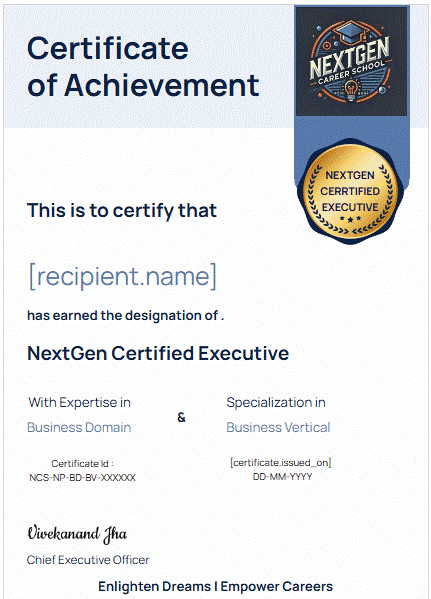
Elevate your resume with NextGen certification
Get Certified as a Business Executive
Become a NextGen Certified Business Executive and join an exclusive network of successful professionals who have completed the Mastering in Business Process Analysis program at NextGen Career School.
Start immediately by enrolling through our simple online application process.
Frequently Asked Questions
What is the Mastering in Business Process Analysis program?
The Mastering in Business Process Analysis program is an in-depth course designed to provide students with the skills and knowledge needed to analyze, design, and optimize business processes. The program focuses on techniques for improving efficiency and effectiveness within various organizational workflows.
What are the key benefits of this program?
Key benefits of the program include:
— Comprehensive understanding of business process analysis methodologies and tools.
— Hands-on experience with real-world case studies and projects.
— Enhanced career opportunities in a growing field focused on process optimization.
— Access to expert instructors with industry experience.
— Networking opportunities with fellow students and industry professionals.
How is the program structured?
The program consists of 63 classes divided into 7 modules, with each module containing 9 classes. It is delivered over a 3-month period, with classes held 5 days a week. The curriculum combines theoretical foundations with practical applications in business process analysis.
What career opportunities or pathways are available after completing the course?
After completing the Mastering in Business Process Analysis course, students can pursue various career opportunities such as Business Analyst, Process Improvement Specialist, Operations Manager, and Consultant, allowing them to deepen their expertise and enhance their career prospects.
Who is eligible to join the program?
The program is open to recent graduates, undergraduates, and professionals interested in business process analysis. A basic understanding of business concepts and a willingness to learn are beneficial, but prior experience in process analysis is not mandatory.
What is required to earn the certificate?
o earn the certificate, students must complete all course modules, attend the required classes, and successfully pass the assessments and the capstone project associated with the program.
Are placement services available after the program?
Yes, our placement cell provides support and guidance to students seeking job opportunities after completing the program. This includes resume building, interview preparation, and connections with potential employers in the fields of business process analysis and optimization.
You may also like
Mastering in Robotic Process Automation
Equip professionals with skills to automate tasks, streamline processes, and boost operational efficiency using RPA technologies.
Mastering in Automation Project Management
Equip professionals with skills to manage automation projects effectively, ensuring timely delivery and successful implementation.
Mastering in Data Analytics
Empower professionals to analyze data, uncover insights, and drive data-driven decisions for business optimization.
One-to-One Online Consultation
Tailored Guidance for Your Success
Get personalized, one-to-one online consultations for Career Guidance, Employment Guidance, Admission Guidance with our expert advisors. Receive tailored guidance and actionable insights to achieve your goals.