Mastering in Inventory & Warehouse Management
Your Path to Streamlined Inventory Control
In today’s dynamic business environment, effective inventory and warehouse management is crucial for maintaining smooth operations, reducing costs, and meeting customer demands. Our Mastering in Inventory & Warehouse Management course empowers students with the essential skills and knowledge to manage inventory systems, optimize warehouse operations, and implement best practices in logistics. Tailored for recent graduates and undergraduates, this course covers key topics such as inventory forecasting, stock control, warehouse layout design, and advanced technologies like RFID and automated storage solutions. With a strong focus on practical application, students will engage in hands-on learning, gaining the expertise needed to minimize stockouts, maximize storage efficiency, and support sustainable supply chain practices. This program prepares you for immediate job placement in roles focused on inventory and warehouse management, giving you the tools to excel in a competitive field where precision and efficiency are paramount.
Course Duration
3 Months | 2 hours per day | 5 days a week
Course Fee
Rs.54000/-
*50% at the time of admission & 50% after Internship Earnings or during certification.
Eligibility
undergraduates, Recent graduates, graduates and professionals.
Available Seats
30 Students
Course Advantage
Learning Outcomes
Students will be able to explain the key concepts and principles of inventory and warehouse management, including different types of inventory and their roles within the supply chain.
Learners will demonstrate the ability to apply various inventory control techniques, such as ABC analysis, JIT systems, and demand forecasting methods, to optimize inventory levels and improve operational efficiency.
Participants will be capable of designing efficient warehouse layouts and implementing best practices for warehouse operations, including material handling, picking, packing, and shipping processes.
Students will evaluate and utilize current technologies, such as Warehouse Management Systems (WMS), RFID, and IoT, to enhance inventory accuracy, streamline operations, and support data-driven decision-making.
Graduates will understand the relationship between warehousing and logistics within the broader supply chain context, and will be able to analyze logistics strategies for effective inventory management.
Participants will develop leadership and management skills necessary for effectively leading teams in warehouse settings, fostering a culture of safety, compliance, and continuous improvement.
Learners will assess and implement sustainable practices in inventory and warehouse management, focusing on waste reduction, resource optimization, and the application of circular economy principles.
Reasons to Enroll
As businesses increasingly focus on efficiency and cost-effectiveness, expertise in inventory and warehouse management is highly sought after. This course equips you with essential skills that are critical in today’s competitive job market.
The course offers a well-rounded curriculum that covers all aspects of inventory and warehouse management, from basic principles to advanced technologies, ensuring that you gain a holistic understanding of the field.
With a strong emphasis on practical applications, you will engage in hands-on learning through case studies, simulations, and real-world projects, preparing you for immediate implementation of skills in the workplace.
Completing this program enhances your qualifications, making you a strong candidate for various roles in supply chain and logistics management, leading to better job prospects and career growth.
Learn from experienced instructors and industry professionals who share their insights and experiences, giving you a deeper understanding of current trends, challenges, and best practices in inventory and warehouse management.
By enrolling in this course, you will connect with fellow students, industry professionals, and potential employers, building a valuable network that can assist you in your career journey.
Upon completion of the course, you will receive a recognized certification that enhances your resume and demonstrates your commitment to professional development in inventory and warehouse management.
Career Opportunities & Pathways
Responsible for overseeing inventory levels, implementing control systems, and ensuring optimal stock levels to meet customer demand while minimizing excess inventory costs.
Manages warehouse operations, including receiving, storing, and shipping products, while ensuring efficient layout, safety protocols, and adherence to regulatory standards.
Analyzes data related to supply chain processes, inventory levels, and logistics to identify areas for improvement and help optimize overall supply chain performance.
Coordinates the movement of goods from suppliers to customers, managing shipping schedules, tracking shipments, and ensuring timely deliveries while optimizing logistics costs.
Involves sourcing and purchasing inventory and supplies, negotiating with vendors, and managing relationships to ensure cost-effective procurement strategies.
Oversees day-to-day operations within a warehouse or distribution center, managing teams, monitoring performance metrics, and ensuring adherence to operational standards and policies.
Focuses on monitoring and managing inventory levels, analyzing inventory data for accuracy, and implementing inventory control procedures to reduce discrepancies and improve efficiency.
Curriculum
— Introduction to Inventory & Warehouse Management
— Importance of Inventory Control in Supply Chains
— Inventory Classifications (Raw Materials, Work-in-Progress, Finished Goods)
— Types of Inventory Systems (Periodic vs. Perpetual)
— ABC and XYZ Analysis for Inventory Prioritization
— Economic Order Quantity (EOQ) and Reorder Point
— Safety Stock and Buffer Inventory Management
— Introduction to Warehouse Layout and Design
— Inventory & Warehouse KPIs and Metrics
— Basics of Demand Forecasting in Inventory Management
— Qualitative and Quantitative Forecasting Methods
— Lead Time Analysis and Inventory Planning
— Seasonal Demand Patterns and Planning for Uncertainty
— Inventory Turnover and Optimization
— Stock Replenishment Strategies (Push vs. Pull Systems)
— Planning for High-Value and Slow-Moving Inventory
— Inventory Budgeting and Cost Control
— Case Studies in Demand Forecasting for Inventory Planning
— Warehouse Layout Design and Space Utilization
— Types of Warehousing Systems (Distribution Centers, Cross-Docking)
— Material Handling Equipment and Automation in Warehousing
— Slotting and Zoning Techniques for Efficient Picking
— Warehouse Safety and Compliance Standards
— Receiving and Put-Away Processes
— Picking, Packing, and Shipping Operations
— Reverse Logistics and Returns Management
— Best Practices in Warehouse Operations and Maintenance
— Introduction to Inventory Control Systems (ERP, WMS)
— RFID, Barcoding, and Inventory Tracking Technologies
— Cycle Counting and Physical Inventory Audits
— Real-Time Inventory Visibility and Monitoring
— Inventory Shrinkage and Loss Prevention Strategies
— Inventory Turnover Analysis and Management
— Batch Tracking and Lot Control
— Reorder Points and Safety Stock Calculations
— Emerging Technologies in Inventory Management (IoT, AI)
— Role of Inventory in Supply Chain Coordination
— Procurement and Supplier Relationship Management (SRM)
— Vendor Selection, Evaluation, and Compliance
— Lead Time Optimization and Vendor-Managed Inventory (VMI)
— Supplier Risk Assessment and Contingency Planning
— Collaborative Planning, Forecasting, and Replenishment (CPFR)
— Managing Inventory Across Multiple Warehouses
— Outsourcing and 3PL (Third-Party Logistics) in Inventory
— Case Studies in Effective Vendor and Supplier Management
— Lean Warehousing Principles and Waste Reduction
— Introduction to 5S and its Application in Warehousing
— Inventory Waste Identification and Reduction
— Kaizen and Continuous Improvement in Warehouse Operations
— Standard Operating Procedures (SOPs) for Inventory and Warehouse
— Warehouse Productivity Metrics (Pick Rate, Fill Rate, Cycle Time)
— Analyzing and Optimizing Order Fulfillment Processes
— Balancing Inventory Levels with Service Levels
— Case Studies in Lean and Efficient Warehousing Practices
— Sustainable Inventory Practices and Green Warehousing
— Reducing Environmental Impact in Inventory Management
— Circular Economy and Zero-Waste Inventory Management
— Energy Efficiency in Warehousing Operations
— Corporate Social Responsibility (CSR) in Inventory Management
— Emerging Trends in Inventory Management (Automation, AI, Big Data)
— Blockchain for Inventory and Supply Chain Transparency
— Global Inventory and Warehousing Strategies
— Future of Inventory & Warehouse Management in a Digital World
Certification
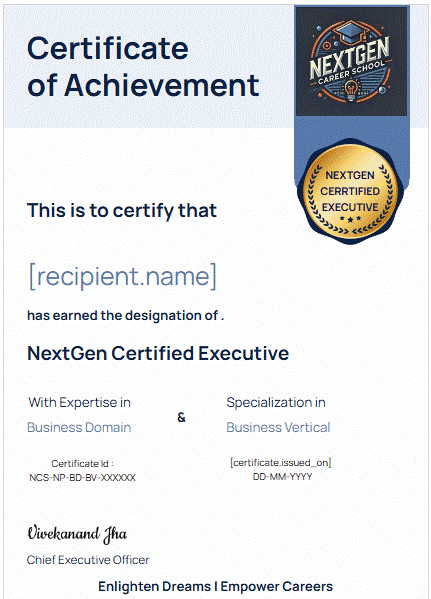
Elevate your resume with NextGen certification
Get Certified as a Business Executive
Become a NextGen Certified Business Executive and join an exclusive network of successful professionals who have completed the Mastering in Inventory & Warehouse Management program at NextGen Career School.
Start immediately by enrolling through our simple online application process.
Frequently Asked Questions
The Mastering in Inventory & Warehouse Management program is a comprehensive course designed to equip students with the essential knowledge and skills needed to effectively manage inventory and optimize warehouse operations. This program covers key concepts, technologies, and best practices in inventory management, warehouse design, logistics, and supply chain operations.
The program equips students with:
— In-Demand Skills: Develop critical skills that are highly sought after in the logistics and supply chain industry.
— Hands-On Learning: Engage in practical applications through case studies and simulations, preparing you for real-world scenarios.
— Comprehensive Curriculum: Gain a well-rounded understanding of inventory and warehouse management, covering various essential topics.
— Networking Opportunities: Connect with industry professionals and fellow students to expand your professional network.
— Career Advancement: Enhance your qualifications and job prospects in a growing field.
The program consists of 7 modules, each containing 9 classes, for a total of 63 classes. Each module covers different aspects of inventory and warehouse management, including inventory control techniques, warehouse operations, logistics, and the use of technology in management practices.
Graduates can pursue a variety of roles, including Inventory Manager, Warehouse Manager, Supply Chain Analyst, Logistics Coordinator, Procurement Specialist, Operations Supervisor and Inventory Control Analyst.
The program is open to recent graduates, undergraduates, and professionals looking to enhance their skills in inventory and warehouse management. No prior experience in logistics is required, although a background in business or management can be beneficial.
To earn the certificate, students must complete all course modules, participate in class projects, and pass assessments throughout the program. Attendance and active participation in discussions and group activities may also be required.
Yes, the program offers placement services to assist graduates in finding suitable job opportunities. This includes career counseling, resume building, and interview preparation to enhance students’ chances of securing employment in the field.
You may also like
Matering in Quality Management and Six Sigma
Equip professionals with skills to implement quality systems and Six Sigma, driving process improvement and excellence.
Mastering in Supply Chain Management
Equip professionals with skills to optimize supply chain processes, enhance efficiency, and manage logistics for business success.
Mastering in Data Analytics
Empower professionals to analyze data, uncover insights, and drive data-driven decisions for business optimization.
One-to-One Online Consultation
Tailored Guidance for Your Success
Get personalized, one-to-one online consultations for Career Guidance, Employment Guidance, Admission Guidance with our expert advisors. Receive tailored guidance and actionable insights to achieve your goals.