Mastering in Robotic Process Automation
Revolutionizing Business Efficiency Through Automation
In today’s rapidly advancing technological landscape, mastering Robotic Process Automation (RPA) is crucial for elevating operational efficiency and driving impactful results. Our Mastering in Robotic Process Automation course is expertly crafted to provide students with the advanced skills necessary to excel in this dynamic field. Designed for recent graduates and professionals, this program emphasizes practical application, ensuring you gain hands-on experience with leading RPA tools such as UiPath and Automation Anywhere.
Through engaging projects and personalized mentorship, you’ll learn to design and implement RPA solutions that transform business operations. Unlock the potential of RPA, enhance your career prospects, and position yourself as a key player in the future of work, ready to tackle real-world automation challenges with confidence. Join us and be at the forefront of the automation revolution, where your expertise can make a significant impact on business success!
Course Duration
3 Months | 2 hours per day | 5 days a week
Course Fee
Rs. 54000/-
*50% at the time of admission & 50% after Internship Earnings or during certification.
Eligibility
undergraduates, Recent graduates, graduates and professionals.
Available Seats
30 Students
Course Advantage
Learning Outcomes
Students will gain a thorough understanding of Robotic Process Automation, including its core principles, architecture, and the significance of RPA in enhancing operational efficiency across various industries.
Students will develop hands-on experience with popular RPA tools such as UiPath, Automation Anywhere, and Blue Prism, enabling them to effectively create, deploy, and manage automation solutions.
Students will learn how to analyze business processes for automation potential, design effective RPA workflows, and create process maps that clearly outline the steps for automation.
Students will acquire the skills needed to develop RPA bots for various applications, including data extraction, manipulation, and integration with external systems, ensuring they can automate repetitive tasks efficiently.
Students will understand the steps involved in deploying RPA solutions in production environments, including monitoring bot performance, managing bots effectively, and troubleshooting common issues.
Students will learn about the best practices for RPA implementations, including establishing governance frameworks, managing risks, and ensuring compliance, which are crucial for successful RPA adoption in organizations.
Students will prepare for career opportunities in the field of RPA by building a professional portfolio, developing interview skills, and understanding industry certifications, job roles, and current market trends.
Reasons to Enroll
The demand for professionals skilled in RPA is rapidly increasing as businesses seek to automate processes and improve efficiency. This course prepares you for a career in a growing field with abundant job opportunities.
The course offers practical, hands-on training with leading RPA tools like UiPath, Automation Anywhere, and Blue Prism, allowing you to gain real-world experience and develop skills that are directly applicable in the workplace.
With a well-structured curriculum covering everything from RPA fundamentals to advanced deployment strategies, this course provides a thorough understanding of RPA, equipping you with the knowledge needed to tackle various automation challenges.
Completing this course positions you to enter the job market quickly, as RPA skills are in high demand. You will be prepared to apply for roles such as RPA Developer, Analyst, or Consultant, increasing your employability.
The course includes real-world projects and case studies, enabling you to build a professional portfolio that demonstrates your RPA capabilities to potential employers and showcases your problem-solving skills.
By enrolling in this course, you will connect with instructors and peers who are also passionate about automation. Networking with industry professionals can lead to job opportunities, mentorship, and collaborations.
The course prepares you for industry-recognized certifications in RPA, which can further enhance your resume and validate your skills to prospective employers, setting you apart in a competitive job market.
Career Opportunities & Pathways
Develop and implement RPA solutions using automation tools. RPA Developers focus on creating bots that automate repetitive tasks, making processes more efficient across various business functions.
Analyze business processes to identify automation opportunities. RPA Business Analysts work with stakeholders to understand requirements, create process maps, and design effective automation strategies.
Provide expert guidance to organizations on RPA adoption. RPA Consultants assess current processes, recommend automation solutions, and help implement strategies that align with business objectives.
Design comprehensive automation frameworks for organizations. Process Automation Architects are responsible for developing scalable and sustainable automation solutions that meet the unique needs of the business.
Oversee RPA implementation projects from start to finish. Automation Project Managers coordinate teams, manage timelines, and ensure successful delivery of automation solutions within budget and scope.
Focus on automating data-related tasks, such as data extraction, transformation, and reporting. Data Automation Specialists utilize RPA tools to streamline data processes, ensuring accuracy and efficiency.
Work with organizations to integrate RPA into their overall digital transformation strategy. Digital Transformation Consultants help businesses leverage automation to enhance operational efficiency and drive innovation.
Curriculum
— Overview of RPA and its significance in the digital landscape.
— Key components of RPA architecture.
— Differences between RPA and traditional automation.
— Common applications of RPA across industries.
— Understanding RPA tools and their features.
— Case studies on successful RPA implementations.
— Future trends and the evolving role of RPA in business.
— The impact of RPA on job roles and workforce transformation.
— Introduction to popular RPA tools (UiPath, Automation Anywhere, Blue Prism).
— Setting up the RPA development environment.
— Navigating RPA tool interfaces.
— Creating your first RPA project: Step-by-step guide.
— Understanding bot execution and debugging.
— Managing dependencies and library integration.
— Version control in RPA projects.
— Best practices for maintaining an RPA environment.
— Analyzing business processes for automation suitability.
— Mapping processes using workflow diagrams.
— Designing RPA workflows: Sequence and flowchart activities.
— Using selectors to interact with applications.
— Implementing error handling and exception management.
— Best practices for workflow design and documentation.
— User acceptance testing (UAT) for RPA solutions.
— Real-world project: Designing a sample RPA solution.
— Developing RPA bots for data extraction and manipulation.
— Integrating RPA with databases and APIs.
— Automating interactions with web applications.
— Implementing OCR (Optical Character Recognition) for document processing.
— Creating bots for email automation and notifications.
— Performance tuning and optimization of RPA bots.
— Handling dynamic web elements and user interfaces.
— Real-world project: Developing an RPA bot for a business process.
— Steps for deploying RPA solutions in production.
— Managing RPA bots in an enterprise environment.
— Monitoring bot performance and metrics.
— Implementing governance and compliance in RPA projects.
— Troubleshooting common RPA deployment issues.
— Scaling RPA solutions across departments.
— Creating a roadmap for RPA implementation in an organization.
— Real-world project: Deploying and managing an RPA solution.
— Establishing an RPA center of excellence (CoE).
— Developing RPA governance frameworks and policies.
— Change management strategies for RPA implementations.
— Risk management and compliance considerations.
— Continuous improvement and optimization of RPA processes.
— Collaborating with stakeholders for successful RPA adoption.
— Measuring ROI and business impact of RPA initiatives.
— Case studies on RPA governance and best practices.
— Building a professional portfolio of RPA projects.
— Resume writing and interview preparation for RPA roles.
— Networking strategies and leveraging online platforms.
— Industry certifications in RPA and automation.
— Understanding job roles: RPA Developer, Analyst, and Consultant.
— Current trends and demands in the job market for RPA.
— Mock interviews and feedback sessions.
— Career path planning and job search strategies.
Certification
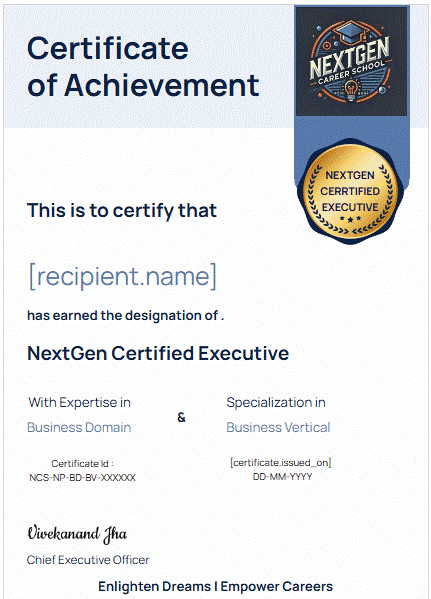
Elevate your resume with NextGen certification
Get Certified as a Business Executive
Become a NextGen Certified Business Executive and join an exclusive network of successful professionals who have completed the Mastering in Robotic Process Automation program at NextGen Career School.
Start immediately by enrolling through our simple online application process.
Frequently Asked Questions
The Mastering in Robotic Process Automation program is a comprehensive course designed to equip students with the knowledge and skills needed to design, develop, and implement RPA solutions. The program covers various automation tools and techniques to enhance operational efficiency across different business functions.
Key benefits of the program include:
— In-depth understanding of RPA tools and technologies.
— Hands-on experience with real-world automation projects.
— Enhanced career opportunities in a rapidly growing field.
— Access to expert instructors and industry professionals.
— Networking opportunities with peers and industry leaders.
The program consists of 63 classes divided into 7 modules, each containing 9 classes. It is delivered over a 3-month period, with classes held 5 days a week. The curriculum is designed to provide both theoretical knowledge and practical skills in RPA.
After completing the Mastering in Robotic Process Automation course, students can explore various career opportunities such as RPA Developer, Automation Consultant, Business Process Analyst, RPA Project Manager, and more, further enhancing their skills and career prospects.
The program is open to recent graduates, undergraduates, and professionals interested in RPA. A foundational understanding of business processes and familiarity with technology is beneficial, but not mandatory.
To earn the certificate, students must complete all course modules, attend the required classes, and successfully pass the assessments and project work associated with the program.
Yes, our placement cell offers support and guidance to students seeking job opportunities after completing the program. This includes resume building, interview preparation, and connecting graduates with potential employers in the RPA field.
You may also like
Mastering in Data Analytics
Empower professionals to analyze data, uncover insights, and drive data-driven decisions for business optimization.
Mastering in Business Process Analysis
Equip professionals with skills to analyze and optimize business processes for greater efficiency and decision-making.
Mastering in Automation Project Management
Equip professionals with skills to manage automation projects effectively, ensuring timely delivery and successful implementation.
One-to-One Online Consultation
Tailored Guidance for Your Success
Get personalized, one-to-one online consultations for Career Guidance, Employment Guidance, Admission Guidance with our expert advisors. Receive tailored guidance and actionable insights to achieve your goals.