Mastering in Business Intelligence
Transform Data into Decisions
In today’s data-driven world, businesses rely on actionable insights to make informed decisions and stay competitive. Our Mastering in Business Intelligence course equips you with the essential skills to analyze data, create impactful visualizations, and apply advanced analytics for strategic and operational decision-making. Designed for recent graduates and aspiring professionals, this program combines hands-on learning with real-world applications to prepare you for a successful career in data analytics and business intelligence. Gain the tools you need to transform data into a powerful asset for driving business success. Through industry-relevant case studies and cutting-edge tools, you’ll master techniques that allow you to turn raw data into valuable business insights. Unlock your potential to lead data-driven strategies that shape the future of business and become a key player in driving organizational growth through data intelligence.
Course Duration
3 Months | 2 hours per day | 5 days a week
Course Fee
Rs. 45000/-
50% payable at the time of admission and the remaining 50% through monthly installments during the internship period.
Eligibility
undergraduates, Recent graduates, graduates and professionals.
Available Seats
36 Students
Course Advantage
Learning Outcomes
Develop a solid foundation in Business Intelligence principles, including data warehousing, ETL processes, and data mining techniques.
Gain expertise in gathering, cleaning, and preparing data from various sources, ensuring high data quality and accuracy for analysis.
Learn to create impactful visualizations and reports using BI tools like Power BI, Tableau, and Excel, effectively communicating insights to stakeholders.
Utilize predictive and prescriptive analytics to uncover trends, forecast outcomes, and support strategic decision-making within an organization.
Use BI techniques to analyze and optimize business processes, improve resource allocation, and enhance overall operational performance.
Understand how to apply BI solutions across various business areas, aligning data insights with business goals to drive growth and innovation.
Develop a thorough understanding of data governance, privacy regulations, and ethical considerations, ensuring responsible and compliant use of data in business.
Reasons to Enroll
As data becomes the backbone of business strategy, the demand for skilled Business Intelligence professionals is skyrocketing across all industries.
Gain practical experience with top BI tools like Power BI, Tableau, and Excel, ensuring you’re job-ready with real-world skills.
Learn how to transform raw data into actionable insights that support strategic decision-making, giving you a competitive edge in any business environment.
Business Intelligence is a versatile skill applicable to various roles, from data analyst to BI consultant, offering a wide range of career pathways.
Learn to optimize business processes, improve efficiency, and drive innovation through the use of advanced BI techniques.
Develop the expertise to keep pace with the evolving field of data analytics and BI, ensuring long-term career relevance and growth.
Earn a certification that validates your BI skills and knowledge, enhancing your credibility and employability in the job market.
Career Opportunities & Pathways
BI Analysts interpret data to provide actionable insights, guiding strategic decisions that improve business efficiency, profitability, and growth.
Data Analysts work with large datasets to identify trends, generate reports, and support data-driven decision-making, playing a key role in optimizing business operations.
These specialists create visual representations of data using charts, graphs, and dashboards, helping stakeholders understand complex information quickly and clearly.
Business Intelligence Developers design, build, and maintain BI tools and systems, ensuring data is easily accessible, processed, and visualized for ongoing analysis and reporting.
Data Engineers build data pipelines and infrastructure, facilitating smooth data flow and storage that supports BI functions and analytical capabilities.
Market Research Analysts use BI tools to analyze market data, understand customer behavior, and identify trends, providing insights that shape marketing and sales strategies.
Performance Analysts evaluate organizational metrics to identify areas for operational improvement, helping companies enhance productivity and reduce inefficiencies.
Curriculum
— What is Business Intelligence? – Definition, Importance, and Evolution
— Business Intelligence vs Data Analytics – Key Differences and Overlap
— Data Types in BI – Structured, Semi-structured, and Unstructured Data
— BI Components – Data Sources, Data Warehouse, ETL, Analytics, and Reporting
— BI Tools Overview – Popular BI Tools (Power BI, Tableau, QlikView)
— BI and Decision Making – How BI Supports Better Decision-Making Processes
— Understanding Key Performance Indicators (KPIs) – Their Role in BI
— The Role of Dashboards in BI – Overview and Types of Dashboards
— Real-World Use Cases of BI – How Businesses Benefit from BI Solutions
— Data Collection Methods for BI – Survey, Web Scraping, Transactional Data, etc.
— Understanding Data Sources – Internal and External Data Sources
— Data Quality Management – Ensuring Accuracy, Completeness, and Consistency
— Data Cleaning Techniques – Handling Missing Data, Outliers, and Errors
— Data Integration – Merging Data from Multiple Sources
— Data Transformation for BI – Normalization, Aggregation, and Filtering
— ETL (Extract, Transform, Load) Process – Overview and Importance
— Data Warehousing Concepts – Building Centralized Repositories for BI
— Data Governance in BI – Ensuring Security, Privacy, and Compliance
— Introduction to Data Visualization – Purpose and Importance
— Types of Visualizations – Bar Charts, Line Graphs, Pie Charts, and More
— Choosing the Right Visualization – Matching Data to Visual Formats
— Introduction to Power BI/Tableau – Overview of Visualization Tools
— Building Dashboards – Combining Multiple Visuals for Reporting
— Interactive Reporting – Creating Dynamic Reports and Drill-down Analysis
— Best Practices for Effective Visualization – Avoiding Misleading Graphics
— Advanced Visualizations – Heatmaps, Scatter Plots, and Tree Maps
— Sharing and Presenting Data – Effective Communication with Stakeholders
— Introduction to Advanced Analytics – Predictive, Prescriptive, and Descriptive
— Data Modeling Techniques – Regression, Classification, and Clustering
— Forecasting Techniques in BI – Time-Series Analysis, Moving Averages
— Machine Learning in BI – Incorporating AI for Predictive Analytics
— Predictive Analytics in BI – Use Cases and Techniques
— Prescriptive Analytics – Optimization and Decision Support in BI
— Real-Time Analytics – Processing and Analyzing Live Data Streams
— Sentiment Analysis in BI – Analyzing Text and Social Media Data
— Case Studies of Advanced Analytics in Business Intelligence – Real-World Applications
— BI for Strategic Planning – How BI Helps in Setting Long-Term Goals
— Competitive Intelligence – Using BI to Analyze Market and Competitors
— BI for Market Analysis – Identifying Trends and Patterns
— Business Performance Monitoring with BI – Measuring Success Through KPIs
— Customer Analytics with BI – Understanding Customer Behavior and Preferences
— Supply Chain Analytics – Optimizing Operations Through BI
— Sales Forecasting with BI – Predicting Revenue and Sales Trends
— Scenario Planning in BI – Simulating Different Business Outcomes
— Using BI to Drive Innovation – Discovering Opportunities for Growth
— Operational Analytics in BI – Overview and Importance
— Process Optimization with BI – Identifying and Eliminating Inefficiencies
— BI for Resource Allocation – Optimizing the Use of Labor, Capital, and Materials
— Supply Chain Optimization with BI – Reducing Costs and Improving Delivery Times
— BI in Manufacturing Operations – Analyzing Production Data
— Inventory Management with BI – Optimizing Stock Levels and Reducing Waste
— Financial Analytics with BI – Cost Analysis, Budgeting, and Forecasting
— Workforce Analytics in BI – Improving Employee Productivity and Satisfaction
— Case Studies in Operational BI – How Businesses Achieve Operational Excellence
— Data Privacy in Business Intelligence – Protecting Customer and Company Data
— Ethical Use of Data – Avoiding Bias, Discrimination, and Misinformation
— Regulatory Compliance in BI – Understanding GDPR, CCPA, and Other Laws
— Data Security in BI – Protecting Data from Breaches and Cyberattacks
— BI Governance – Policies and Procedures to Ensure Data Integrity
— AI and Machine Learning in BI – The Role of Artificial Intelligence in the Future of BI
— Big Data and BI – Leveraging Large Datasets for Deeper Insights
— BI in the Cloud – Cloud-Based Solutions for Scalable BI
— Future Trends in Business Intelligence – Predicting the Next Big Innovations in BI
Certification
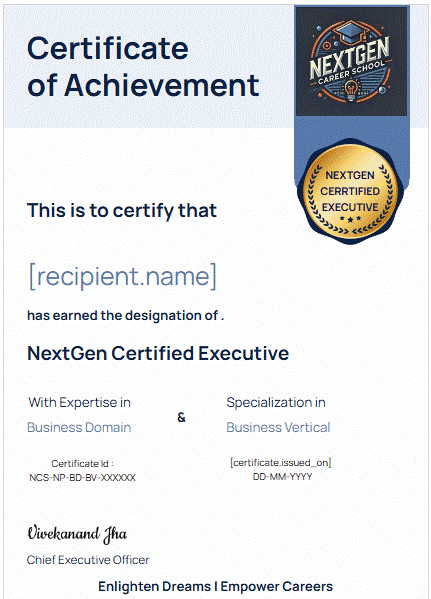
Elevate your resume with NextGen certification
Get Certified as a Business Executive
Become a NextGen Certified Business Executive and join an exclusive network of successful professionals who have completed the Mastering in Business Inteliigence program at NextGen Career School.
Start immediately by enrolling through our simple online application process.
Frequently Asked Questions
The Mastering in Business Intelligence program is designed to equip students with the skills and knowledge needed to analyze data, create visualizations, and apply advanced analytics to support strategic business decision-making.
Key benefits include gaining hands-on experience with industry-standard BI tools, mastering data-driven decision-making, enhancing career opportunities in a high-demand field, and earning a recognized certification.
The program consists of 7 modules, each with 9 classes, covering topics such as data visualization, advanced analytics, and ethical considerations in BI, ensuring a comprehensive learning experience.
After completing the program, students may have the opportunity to specialize in areas such as Business analytics, Data analytics and Data Visualization.
The program is open to recent graduates, undergraduates, and early-career professionals interested in data analytics and Business Intelligence. There are no formal prerequisites.
To earn the certificate, students must complete all course classes, participate in the internship, and successfully pass any assessments or evaluations.
Yes, we offer placement services to assist graduates in finding job opportunities in the Business Intelligence field, including access to an alumni network and job search resources.
Focused Specialization Programs
Mastering in Business Analytics
Equip professionals with the skills to leverage data for strategic business decisions, driving growth, efficiency, and competitive advantage.
Mastering in Data Analytics
Empower professionals to analyze data, uncover insights, and drive data-driven decisions for business optimization.
Mastering in Data Visualization
Equip professionals with the skills to turn complex data into impactful visuals, enabling clearer insights and smarter business decisions.
One-to-One Online Consultation
Tailored Guidance for Your Success
Get personalized, one-to-one online consultations for Career Guidance, Employment Guidance, Admission Guidance with our expert advisors. Receive tailored guidance and actionable insights to achieve your goals.